The final pass
Alexia Putellas’s last match for Barcelona did not end with one of her goals. It ended, somehow, with something even more fitting.
The 34th minute against Real Sociedad. Alexia took the ball, lifted her head and found Aitana Bonmatí. The move ended in a 2-1 —Aitana’s first goal since returning from injury—. It was the captain’s last assist in the blue-and-red shirt: a pass between two footballers who have shared the midfield, the great titles and the recognition of being considered the best in the world.
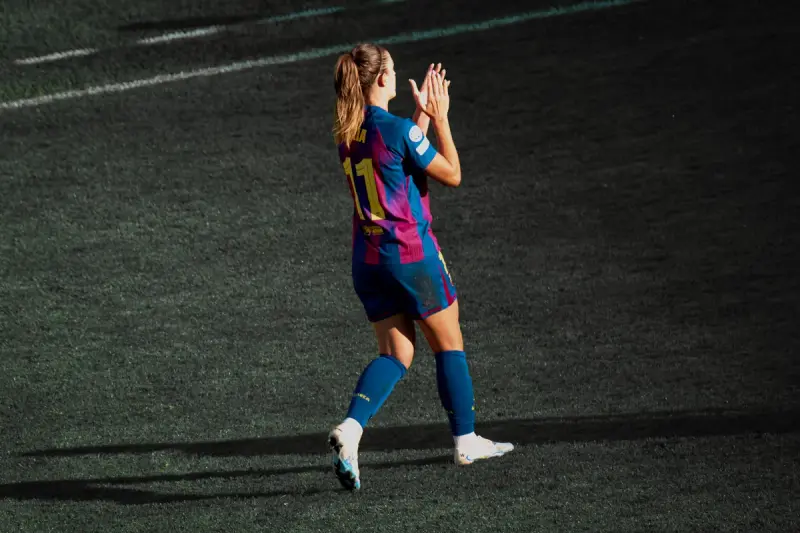
In the 81st minute, Alexia left the pitch for the last time. Her team-mates and the Real Sociedad players formed a guard of honour. The Estadi Johan Cruyff rose to its feet. There was no final at stake and no trophy waiting on the grass. All that was left was to say goodbye to the footballer who had been with the team from the moment it began to win in Spain until it learned to rule Europe.
The scene contained her whole career. Alexia was not leaving because she could no longer play. Days earlier she had lifted her fourth Champions League and been named the competition’s best player. She was leaving because she had decided that her story with Barça should end at the top, while she could still choose the moment.
Related read: Aitana Bonmatí: the player who turned midfield into an art
Before the throne existed
The nickname the Queen is convenient. It sums up the prizes, the authority, the armband and the trophy celebrations. But it can also hide the most important part of her journey: Alexia did not inherit a kingdom already built.
She was born in Mollet del Vallès on 4 February 1994. She passed through CE Sabadell, Barcelona’s youth ranks and Espanyol, and played a season at Levante before returning to Barça for good in 2012, aged 18.
It was a different women’s football. There was talent, there were competitions and there were players capable of filling stadiums if someone gave them the stage, but there was a lack of structure, resources and attention. The blue-and-red side was not yet the global power we know: it did not rule Europe, it did not draw more than 90,000 people to Camp Nou, and its players did not front advertising campaigns or win the Ballon d’Or.
Alexia arrived before all of that. In her early seasons she won leagues and cups, grew alongside footballers like Melanie Serrano, Vicky Losada, Marta Torrejón and Jenni Hermoso, and took on more responsibility at every stage. She did not turn up one day to transform the team by herself: she stayed while the team transformed. That continuity explains much of her importance. Many footballers have been decisive in the great Barcelona; Alexia was also the thread between the side trying to break through and the one that ended up setting the global standard.
A footballer hard to pin down
Defining Alexia solely as a midfielder has always fallen short. She could start the move near the base, receive between the lines, appear as an attacking midfielder or finish inside the box. She did not beat opponents with extraordinary pace, but by occupying the important space before anyone else.
Her football rested on an exceptional left foot, but above all on timing: she knew when to accelerate and when to make the game wait. She could thread a pass between two defenders, draw a marker, turn in a tiny space or arrive from deep when the attention was on the forward. She was not a number 10 detached from the collective work, nor an interior limited to keeping the ball moving: she was both. She created and she finished.
Barcelona remember two moments that capture her relationship with the spaces women’s football was conquering. On 7 September 2019 she scored the team’s first goal at the newly opened Estadi Johan Cruyff. On 6 January 2021 she became the first woman to score an official goal at Camp Nou. Alexia turned up in the new places and left her name written on them.
The year she stopped being only a Barça star
The 2020/21 season changed Barcelona’s dimension, and its captain’s too. The team won its first Champions League, thrashing Chelsea 4-0 in the Gothenburg final; Alexia scored the second from the penalty spot and was involved in the third. She then completed the treble with the Copa de la Reina, scoring twice in the final against Levante.
She was already an extraordinary footballer. From then on she became a global figure. She won the 2021 Ballon d’Or, FIFA’s The Best award and UEFA’s recognition as the best European player; the club credits her with 42 goals and 32 assists in that calendar year. The following campaign was even more emphatic: she scored 34 goals for Barça and finished as the Champions League top scorer with 11 and, although the team lost the European final to Lyon, UEFA named her the tournament’s best player. In 2022 she won the Ballon d’Or and The Best again. By then, no one could explain world women’s football without naming Alexia Putellas.
The knee
On 5 July 2022, in a Spain training session ahead of the Euros, Alexia suffered a ruptured anterior cruciate ligament in her left knee. It happened at her peak, and days before the tournament: Spain lost its captain and the best footballer in the world vanished from the pitch for almost ten months. She had reached 100 caps with Spain only days earlier —the first Spanish player to do so—; the injury came almost immediately afterwards.
That absence changed her career and also the way her later years would be seen. She returned to play in spring 2023 and, a few months later, was part of the Spain side that won the World Cup in Australia and New Zealand. She did not arrive in full physical condition or with the prominence she would have imagined before tearing her knee, but she won the title Spanish women’s football had been chasing for decades. Her comeback was not about recovering exactly the player of 2021, but about building another version.
Coming back was not the same as returning
For a while, people spoke of Alexia as if her best football belonged to the past. The emergence of Aitana Bonmatí, the growth of other team-mates and the physical after-effects altered her place in the team. Alexia responded without trying to stop time.
In the 2024 Champions League final she came off the bench and, in stoppage time, finished off a Claudia Pina pass inside the box to seal a 2-0 win over Lyon at San Mamés. The 2024/25 season confirmed she was still an elite footballer —39 matches, 22 goals and 16 assists—, and with Spain she was named best player of the 2025 Nations League finals, which the team won for the second time.
But her most emphatic statement came in the 2025/26 Champions League. She racked up seven goals and seven assists —more goal involvements than any other player in the tournament—, Barcelona beat Lyon 4-0 in the Oslo final and Alexia was named the competition’s best player for the second time in her career. It was not a nostalgia prize: almost four years after tearing her cruciate ligament, she was still able to decide the biggest club competition in the world.
Barça grew with her
Alexia closes her time at the club with 508 official matches and 232 goals —the all-time top scorer in Barcelona women’s history— (513 matches and 234 goals if the friendlies the club counts are included). In fourteen seasons she won ten leagues, ten Copas de la Reina, six Spanish Super Cups and four Champions Leagues, plus the Catalan Cups: 38 titles in all.
The numbers explain the scale, but not the whole story. Alexia was captain when Barcelona stopped settling for taking part in Europe and started demanding that it win it. She was there for the first continental final lost to Lyon in 2019, the first Champions League won in 2021, the defeats that forced the team to improve and the titles that turned it into a benchmark. The curve of her career and that of Barcelona women run almost in parallel: when she arrived, the team was building a national hegemony; when she leaves, it is a four-time European champion that plays in front of tens of thousands. She was not the only one responsible —no change of that magnitude belongs to a single footballer— but it is impossible to tell without her.
The national team and the weight of representing
Alexia made her senior debut in 2013 and, as noted, in 2022 became the first Spanish player to reach 100 caps, surpassing Marta Torrejón’s tally to become the player with the most appearances in Spain’s history. Her international journey contains almost the entire recent transformation of the national team: the first World Cup appearances, the early exits, the injury that cost her the 2022 Euros, the 2023 World Cup, the Nations League titles and the 2025 European final, lost to England on penalties.
She has also had to act as a reference point in years when the conversation around the national team went far beyond the pitch. And she is still decisive: in June 2026, with her Barça exit already announced, she scored twice in a 4-0 win over England on the road to the World Cup in Brazil, and Spain then sealed its place by thrashing Iceland. The end of Barça was not the end of Alexia.
What remains after the trophies
In her farewell, Alexia announced that she will stay linked to the club through the FC Barcelona Foundation with the launch of an academy for more than 400 underprivileged young girls. Perhaps that is where an essential part of her legacy lies.
When Alexia started playing, a girl could love football, but she had far fewer close role models, fewer visible paths and less proof that the wish could become a profession. Over her career, Spanish women’s football went from demanding attention to producing world champions, Ballon d’Or winners, full stadiums and footballers known by name. Alexia did not make that transformation alone: before her, there were women who played without contracts, without spotlights and, too often, without recognition; alongside her, there was an irreplaceable generation; after her came footballers who took the game even further. Her place is in the middle of all of them.
She was the player who received a story built on many sacrifices and handed it on turned into something much bigger. The one who was there before the full stadiums and stayed to hear them chant her name. The one who won when almost no one was watching and kept winning when the whole world was.
For years, many girls said they wanted to play like Messi, Iniesta or Xavi, because those were the names football had taught them. Now they can also say they want to be Alexia. And no one needs to ask who they mean.