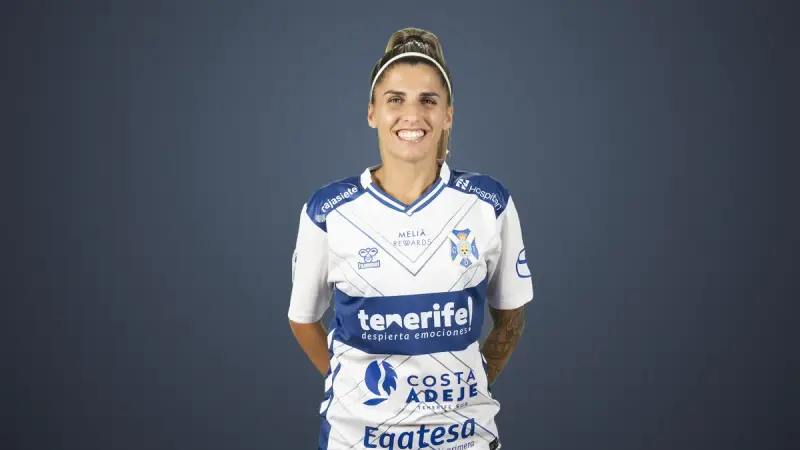
No player spent more time on the pitch during the 2025–26 Liga F season than Natalia Ramos.
It was a total of 2,664 minutes, spanning thirty matchdays and thirty starts, yielding ten goals and five assists. A commanding, ever-present force for Costa Adeje Tenerife.
Yet just one year earlier, she was still learning how to feel like a footballer again.
She had spent eleven months away from the pitch after rupturing the anterior cruciate ligament in her left knee. She came on in the dying minutes of a match against Barcelona in March 2025 and described that return as “the greatest gift” she could have received.
That season, she did not settle for simply coming back.
She played more than anyone.
The girl from La Laguna
Natalia Ramos Álvarez was born on 10 February 1999 in San Cristóbal de La Laguna.
From an early age, she always asked for footballs. She never wanted dolls.
She said as much in 2021, when she had already spent several years in the top flight and was becoming one of the recognisable faces of what was then Granadilla Tenerife. By that point, her story seemed set on a long, stable career at the club from her island.
She had grown up there. She had reached the first division through that structure. She had made her elite debut as a teenager.
She only left once.
In the summer of 2017, she signed for Levante. She was 18 years old and had the chance to test herself away from Tenerife at one of the established projects in Spanish women’s football.
She lasted a season.
In 2018, she came home.
From then on, as the club changed its name, its ground and its scale, Natalia Ramos stayed put. Granadilla became Costa Adeje Tenerife. The competition turned professional. Matches began to fill bigger stadiums. Liga F started receiving the kind of attention that had previously seemed reserved for a handful of players and a handful of clubs.
Natalia was in the middle of all those changes.
Playing.
Two sisters and the same goal at the end of the pitch
Natalia’s story cannot be told in full without Noelia.
They are twin sisters. They grew up chasing the same ball and reached the top division together, though they learned to read the pitch from opposite ends.
Noelia chose the goal.
Natalia started out primarily as a defender and eventually found her best form in central midfield, where she can win the ball, organise play, arrive from deep and make the most of her striking ability from set pieces.
They also went to Levante together in 2017.
After that season, their paths diverged. Natalia returned to Tenerife. Noelia continued her career on the mainland, playing for clubs including Sevilla before returning to the island in 2022.
That was when they shared a dressing room again.
One between the posts. The other a few metres ahead.
Two twins who had grown up at the same club were back together for a different chapter: the club had become a permanent fixture in the elite and was capable of competing with the financially stronger projects in Liga F.
Please let the injuries respect me
In March 2021, Natalia Ramos was asked what goals she still had left to achieve.
She did not name a title, an international call-up or a high-profile transfer.
“I want to enjoy my profession. I want injuries to respect me and to keep enjoying my passion, which is football.”
Three years later, the injuries stopped respecting her.
On 18 April 2024, the club confirmed that Natalia Ramos had suffered a rupture of the anterior cruciate ligament in her left knee.
Her season was over.
The following season began without her too.
A cruciate injury is not simply a matter of repairing a knee. It forces a footballer to step away from the routines that have shaped her entire life: training, competing, travelling, sharing a dressing room and knowing the next match is always just around the corner.
Natalia spent eleven months away.
She returned on 15 March 2025, at the Heliodoro Rodríguez López, against Barcelona. She came on in the final minutes of a match Tenerife lost 0–2, but the result belonged to a different story.
Hers was about having come back.
“The greatest gift I could have had was being able to feel like a footballer again.”
Two months later, still finding her rhythm and closing out a season shaped by rehabilitation, she described in different terms what that process had done to her:
“I am an improved version of the Natalia Ramos I was before.”
The phrase could have sounded like a way of lifting her own spirits.
The following season proved it was a description.
The one who played the most
Natalia Ramos started every one of the thirty Liga F matchdays in 2025–26.
She accumulated 2,664 minutes — one more than Lauri Requena and twelve more than Ainhoa Marín. No footballer in the competition played more.
She was also one of the most influential players at Costa Adeje Tenerife.
Ten goals and five assists. A direct contribution to a goal every 177 minutes. She was the club’s top scorer and shared the lead for assists in the squad.
She won 192 duels — the highest figure in the competition alongside Ainoa Campo. She averaged 6.7 ball recoveries per match and became a constant presence between the two penalty areas.
In April, she was named Liga F Player of the Month.
These were not the numbers of someone who had managed to recover the player she had been before the injury.
They were the numbers of a new player.
Costa Adeje Tenerife finished fourth — ahead of Atlético de Madrid — in one of the best seasons in the club’s history. Natalia was on the pitch for practically the entire journey.
The player who had asked for injuries to respect her responded to the most serious of her career by doing something that would have been difficult to imagine during those months of rehabilitation:
playing more than any of them.
England came to find her
In June 2026, the name Natalia Ramos began appearing in connection with Brighton.
The English club were looking to strengthen their midfield and had turned their attention to one of the standout players of the Spanish season. Natalia was under contract with Costa Adeje Tenerife until 2027, meaning any departure would require an agreement or the payment of her release clause.
That interest did not end in a transfer.
The one that did was Liverpool’s.
At 27, the move to the Women’s Super League does not arrive as a bet on the future. It arrives as recognition for a fully formed footballer — experienced, versatile and coming off a season that allows her impact to be measured without relying on impressions alone.
She is not a promising player from the Canary Islands travelling to find out how far she could go.
She is one of the best midfielders in Liga F arriving in England having already shown exactly who she is.
Staying can also be a way of moving forward
For years, Natalia Ramos built her career away from the spotlight.
She was not at Barcelona or Real Madrid. She did not need to change clubs every few seasons to prove she was improving. She went back to Tenerife after her only stint away and grew alongside the project that had shaped her.
She stayed when the league still had little visibility.
She stayed while the club changed around her.
She stayed after reaching two hundred appearances.
And when an injury threatened to bring her career to a halt, she stayed again — in the rehabilitation, in the invisible work and in the belief that she could still come back better.
In 2021, she had said that women’s football could keep moving forward and that the best was yet to come.
Five years later, the best arrived in the form of thirty starts, 2,664 minutes, ten goals, five assists and an English club coming to find her.
The next chapter is in England.
Natalia Ramos has already changed what the title means.
She was not the one who stayed because she had nowhere else to go.
She was the one who stayed until football had to come and find her.