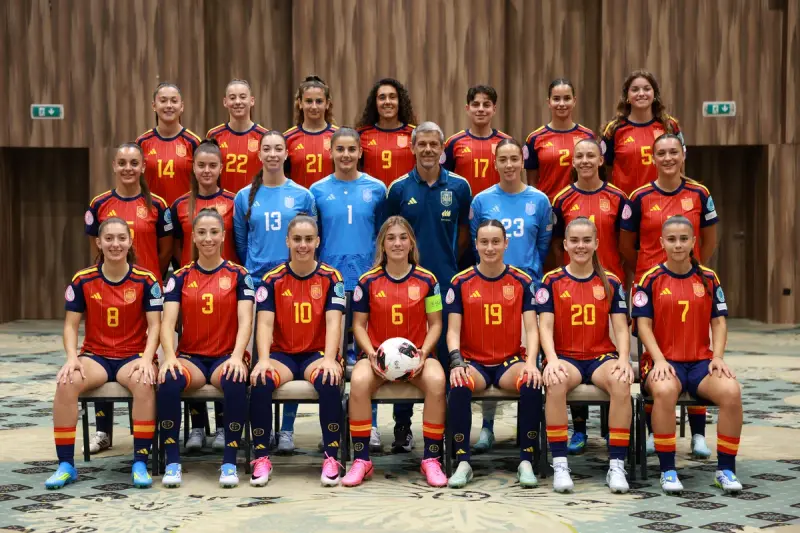
A poor result can be seen in Spain’s draw against Switzerland. The national team mounted a comeback, had chances to seal the win, and ended up conceding the 2-2 equaliser from a highly debatable penalty when victory seemed close.
But when the match is looked at closely, other things also emerge.
You see a capable team. A team making its tournament debut that, even so, showed personality. The kind of personality that shows up when you concede a goal and respond immediately. The kind demonstrated when you are penalised with a debatable penalty in the closing stages and, instead of collapsing, you attack with even more drive in search of victory.
Spain did not win, but they left reasons to believe.
A well-drilled team
Beyond that emotional reaction, a well-drilled team was on display. And that is no easy feat in youth national teams, where preparation periods are usually short and time to build automatisms is limited.
Spain started the match with a theoretical 4-4-2 that clearly transformed when they recovered the ball.
In the attacking phase, the team organised themselves in a 3-2-4-1. The right-back, Emma Moreno, detached from the defence and occupied the entire flank to provide width and depth. For many minutes she featured more as a winger than a defender.
On the opposite side, the left-back tucked inside to complete a back three alongside the two centre-backs. Ahead of them stood two midfielders tasked with sustaining possession and protecting the team against a potential turnover.
The structure allowed Spain to station many players in the opposition half and have a wide player on the right to stretch the pitch.
Switzerland had a clear plan: pack the central area, reduce the spaces between lines, and make it difficult for Spain to progress through central passes. They wanted to turn the midfield into a tangle and force the Spanish team to play where they could do the least damage.
But Spain did not crash against the wall.
They simply went around it on the right.
Emma Moreno was a constant outlet. Her advanced positioning allowed her to receive wide, advance, and deliver crosses into the box. Spain understood that they could not constantly persist through the middle and found another way to approach the goal.
They did not always manage to finish the plays, but they did demonstrate something relevant: they had a plan and knew how to change the path without abandoning the idea.
Rosalía arrived, and so did the tempo
In the second half, the changes arrived. And with them came the tempo.
Rosalía arrived.
It would be unfair to say that Spain’s game depended on her. The national team was already dominant before her introduction, had already created chances, and had already shown they could pin Switzerland back.
But there are players capable of adding exactly what the game is lacking to the pitch. David Aznar understood what his team needed, and Rosalía Domínguez interpreted the instruction perfectly.
She came on with the same hunger as her teammates, or perhaps a little more. She stayed wide on the left wing to finish stretching the pitch from the opposite side to Emma Moreno. Spain began to threaten on both flanks and forced Switzerland to defend many more yards.
Rosalía did not limit herself to sticking to the touchline and waiting for the ball.
Every movement by her teammates was information. If someone dragged a defender away, she occupied the vacated space. If the play demanded width, she stayed wide. If she found an inside channel, she drove inwards and threatened with a shot.
She offered herself, beat her defender, accelerated, shot from distance, attacked the space, and lifted her head to assist.
She did practically everything, and in every way.
Her influence was clearly visible in the second goal. After several shooting attempts, she received near the edge of the area. The Swiss defence expected another individual action and focused their attention on her. Rosalía controlled, watched Ainoa’s run, and sent a measured pass for her teammate to complete the comeback.
It wasn’t just an assist. It was the consequence of everything that had happened before. Switzerland feared Rosalía’s shot and stopped watching the runner arriving from behind.
That’s where Ainoa Gómez appeared.
Two goals and plenty of intent
Ainoa was the other major protagonist of the match, and not just for scoring Spain’s two goals.
Her game was also a demonstration of how to interpret space.
She started from a position close to the playmaker role, behind the striker. In theory, this was precisely the area Switzerland wanted to close down with their defensive block. Staying there, surrounded and waiting for the ball to feet, would have meant disappearing inside the Swiss defensive structure.
Ainoa chose otherwise.
Instead of insisting on receiving between the lines, she attacked the spaces again and again. She crossed runs with the striker, appeared behind the midfielders, and arrived from the second line when the defenders were focused on other threats.
Her two goals were important. Her intent throughout the match, even more so.
For the first, she reacted immediately to Switzerland’s goal and found the necessary strike to restore parity. For the second, she understood where to appear while Rosalía attracted the defence.
Two goals, yes. But also a match full of intelligent movements.
Something more than a draw
Spain ended up drawing. They can regret the chances they didn’t convert, the penalty awarded in the closing stages, and a victory they held in their hands for many minutes.
They will also have to correct things. Their high press left spaces behind, and Switzerland managed to generate danger when they bypassed the first line. Attacking ambition demands precision and a good reaction after turnovers, because any mistake can leave the centre-backs defending many yards.
But this team did not hide.
They wanted to propose, press, settle in the opposition half, and win. When they conceded the first goal, they responded. When they equalised at the end, they attacked again. In stoppage time they did it perhaps with more heart than head, but they never resigned themselves.
The match ended 2-2.
Yet, this Spain won something in their debut. They showed that they have an idea, that they know how to compete, and that they possess players capable of understanding what is happening on the pitch.
At the very least, they won my trust.
Keep it up, girls. This has only just begun.