Follow the Women’s U19 Euro: Match schedule, results, and group standings in our tournament tracking page.
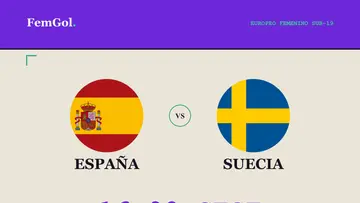
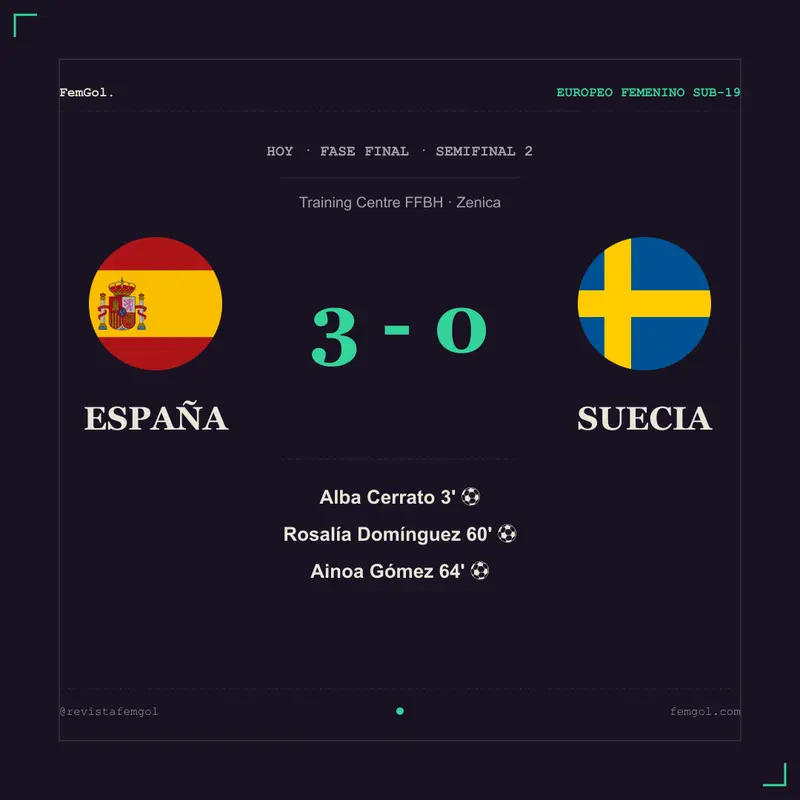
Spain will contest a fifth consecutive UEFA Women’s Under-19 EURO final. The reigning champions defeated Sweden 3-0 in Zenica in their 11th successive semi-final, controlling the match from the opening minute before settling it through goals from Alba Cerrato, Rosalía Domínguez and Ainoa Gómez.
Less than three minutes had been played when Spain found the opener. Rosalía received the ball on the left and found Alba Cerrato, who controlled with her back to goal, turned and sent the ball into the top corner. A brilliant goal to open a semi-final that Sweden had approached from a very deep defensive block.
Spain moved the ball from side to side while waiting for space to appear. Rosalía threatened from the left, Emma Moreno advanced down the opposite flank and Celia Segura repeatedly found shooting positions near the penalty area. Around the half-hour mark, Spain’s share of possession had reached 81%.
Sweden attempted to change the direction of the match after the cooling break. They pressed higher, increased the physical intensity and gave Fanny Peterson greater freedom to appear in more advanced areas, with Nova Selin moving wider. Elene Gurtubay was shown a yellow card in the 38th minute after stopping Priks.
Sweden’s pressure occasionally pushed the game towards the Spanish penalty area, although without producing any clear chances. Laia López had to leave her goal and head away a ball played in behind shortly before half-time. Spain went into the dressing room with a narrow advantage that did not fully reflect their control.
Sweden returned with an additional attacker and a willingness to take more risks. Filippa Sjöström replaced Nicole Molin Kock as the team moved into a 4-3-3. Their press became higher and more aggressive, although repeated stoppages caused by Hanna Karlsson’s physical discomfort and a blow suffered by a Swedish player slowed their early momentum.
The match became more physical and increasingly congested in midfield. For several minutes, most of the attacking situations came from rebounds, clearances and second balls rather than constructed moves.
Spain needed one recovery to impose order once again. Irune won the ball in defence and played long towards Alba Cerrato on the left touchline. The forward controlled and passed inside to Rosalía, who combined with Irune, continued her run and received the return ball. Sweden allowed her time to think. Rosalía looked up and placed her finish towards the far post to make it 2-0 in the 60th minute.
Irune once again showed that she plays with a complete map of the pitch in her head. She constantly looks to both sides, checks what is happening behind her and receives the ball already knowing where her teammates and opponents are. She may finish matches with a sore neck, but many of Spain’s solutions begin with what she sees before receiving the ball.
The third arrived four minutes later. Rosalía received the ball near the side of the penalty area, showed it to the defender, took it away again and created the space to cross. Ainoa Gómez arrived from deep and headed the ball into the net to settle the semi-final.
Rosalía finished the match with one goal and two assists. Ainoa joined her, Alba Cerrato and Switzerland’s Emanuela Pfister at the top of the tournament’s scoring chart, all with three goals.
Sweden responded by committing more players to the attacking third. They made a triple substitution and pushed their lines even higher, forced to take risks both in attack and when building from the back.
David Aznar responded by introducing Iris Ashley in place of Celia Segura. Her task appeared clear: prevent Sweden’s defenders from starting attacks comfortably. Every loss of possession could become a Spanish transition.
Spain began to find quick routes forward after recovering the ball, exploiting the spaces Sweden were leaving behind. When there was room to run, they accelerated. When there was not, they kept possession, linked passes together and forced their opponents to retreat once again.
Adriana Folgado replaced Ainoa Gómez in the 75th minute. Spain no longer needed to rush. They alternated counterattacks with long spells of possession and retained control of a semi-final that had effectively been decided.
From approximately the 85th minute, RTVE decided that watching Spain full-screen might be excessive and used a large part of the picture to show a small inset featuring replays from the end of the Tour stage, which was already being broadcast on RTVE’s main channel, La 1.
As FemGol is still learning and Spain’s public broadcaster is always a benchmark, we will not report on those minutes. We assume that, if they did not deserve the whole screen, they cannot have been particularly important.
Only a few seconds after the final whistle, the broadcast cut away and returned to the Tour, with the commentators still speaking and the Spanish players only beginning to celebrate on the pitch.