Follow the Women’s U19 Euro: Check the schedule, results, and full coverage of the Spanish national team in our tournament tracking page.
Spain and Germany meet again seven months after that 5-0 victory in Duisburg. The result is part of the context and proves that Spain can hurt this opponent. Treating it as a prediction, however, would be to confuse a previous meeting with the final to be played this Friday.
Germany arrive as group winners, having conceded only one goal and eliminated Austria after 120 minutes in the semi-finals. Spain also topped their group and produced their most complete performance of the tournament against Sweden. David Aznar’s side are chasing a fifth consecutive title; Melanie Behringer’s team are seeking Germany’s first triumph since 2011. Between them, the two countries have won 13 titles at this level.
Spain have grown into the tournament
Spain’s campaign did not begin with a statement performance. They dominated Switzerland in their opening match but allowed their opponents space on the counter-attack and eventually drew 2-2 after conceding a late equaliser. Silvia Cristóbal and Laia López both had to intervene when Switzerland escaped the Spanish press.
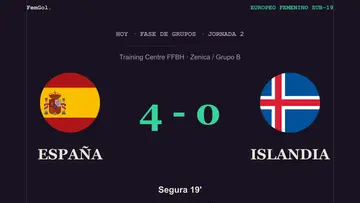
The response came against Iceland. Spain settled the match before half-time through goals from Celia Segura, Rosalía Domínguez — who scored twice — and Alba Cerrato. The comfortable lead allowed David Aznar to distribute minutes and involve more of a squad that has provided different solutions throughout the tournament.
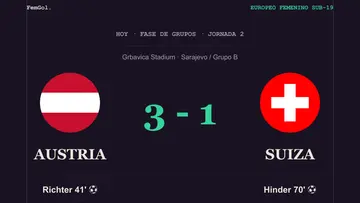
Austria posed a different problem. They sat back, closed the spaces and came close to punishing Spain’s turnovers. Laia won a one-on-one and the post prevented an equaliser after Emira Makalic’s goal. Spain won 2-1 but had to learn how to manage a match that had appeared to be under control.
The semi-final against Sweden brought together much of what Spain had learned. They scored in the third minute, remained patient when the second goal took time to arrive and then settled the match with two goals in four minutes. Alba Cerrato, Rosalía and Ainoa Gómez were the scorers, but the performance was not built around them alone. Spain protected their attacks more effectively, regained possession close to the opposition penalty area and played with greater control than in the previous rounds.
Germany have found a way to compete
The fact that Germany have conceded only once does not fully explain how they have reached the final. Behringer’s side operate with a back three, try to win the ball high up the pitch and use their wide players to progress and deliver into the penalty area.
That approach was clear in the opening 5-0 victory over Bosnia and Herzegovina. Germany defended high, disrupted the hosts’ attempts to play out and repeatedly threatened down the right through Felicia Sträßer.
Against stronger opposition, their control has not always produced clear chances. Germany drew 1-1 with Poland, defeated Sweden 2-0 and needed extra time to overcome Austria. Behringer herself admitted after the Sweden match that her team had made mistakes which allowed several counter-attacks.
The semi-final showed both sides of Germany’s game. They maintained the initiative and created danger through Sträßer, Emma Memminger and crosses from wide areas, but needed 109 minutes to break down Austria’s defensive block. Tessa Zimmermann, who had started on the bench, decided the tie. The return of captain Luzie Zähringer, suspended for the semi-final, also restores an important player for organising the defence and starting attacks.
Germany do not appear willing simply to sit back. Their coach has said that they will try to impose their own game. That intention could produce a more open final than their record of one goal conceded might suggest.
The match could be decided in a second
The final may change in the instant after each turnover. Germany will try to press Spain’s build-up and force Laia López and her defenders to make quick decisions. Irune Dorado, Adriana Folgado or Elene Gurtubay will need to provide passing options so that Spain can escape that pressure without surrendering possession.
If they succeed, spaces will appear. Germany push their wide players forward and accept risks in their attempt to regain the ball high up the pitch. Alba Cerrato can attack the space behind them, Rosalía Domínguez can drive inside, Ainoa Gómez can appear between the lines and Emma Moreno can advance from the flank.
The same danger exists in the other direction. Spain usually attack with several players ahead of the ball, and both Switzerland and Austria showed that they can be exposed when they fail to control a turnover. The next instant will therefore be crucial: regain possession immediately, stop the transition or prevent Germany from running towards Laia’s penalty area.
If Spain fail to react in time, the move could end with a cross, a corner or a second ball — situations from which Germany have already created danger during the tournament. If Germany are late with their own press, however, they will leave space for Spain’s attackers to advance while facing the opposition goal.
Spain must decide when to accelerate and when to retain control. Germany, if they want to challenge for the initiative, will have to accept the spaces created by their pressing. There may be no more than a second between one outcome and the other. That could be where the final is decided.
One final to make it five
Spain are appearing in a fifth consecutive final and can win the eighth Women’s Under-19 European Championship in their history. Germany are seeking a seventh title and the chance to draw level once again in the all-time standings. Spain have won three of the previous four finals between the two countries, including the 2023 meeting on penalties.
December’s 5-0 proves that Spain can beat Germany, but it offers no guarantee that they will do so again. The final brings together a Spanish side that have grown throughout the tournament and an opponent that have developed a structure capable of keeping them in matches.
They will not be playing against the memory of Duisburg. They will be playing for the title.
Confirmed lineups
-
Germany (1-3-4-3): Krumme; Száraz, Zähringer, Müller; Sträßer, Schneider, Omeineder, Memminger; Köpp, Börner, Portella.
Manager: Melanie Behringer. -
Spain (1-4-4-2): Laia López; Emma Moreno, Silvia Cristóbal, Amaya García, Julia Torres; Celia Segura, Irune Dorado, Elene Gurtubay, Rosalía Domínguez; Ainoa Gómez, Alba Cerrato.
Manager: David Aznar.
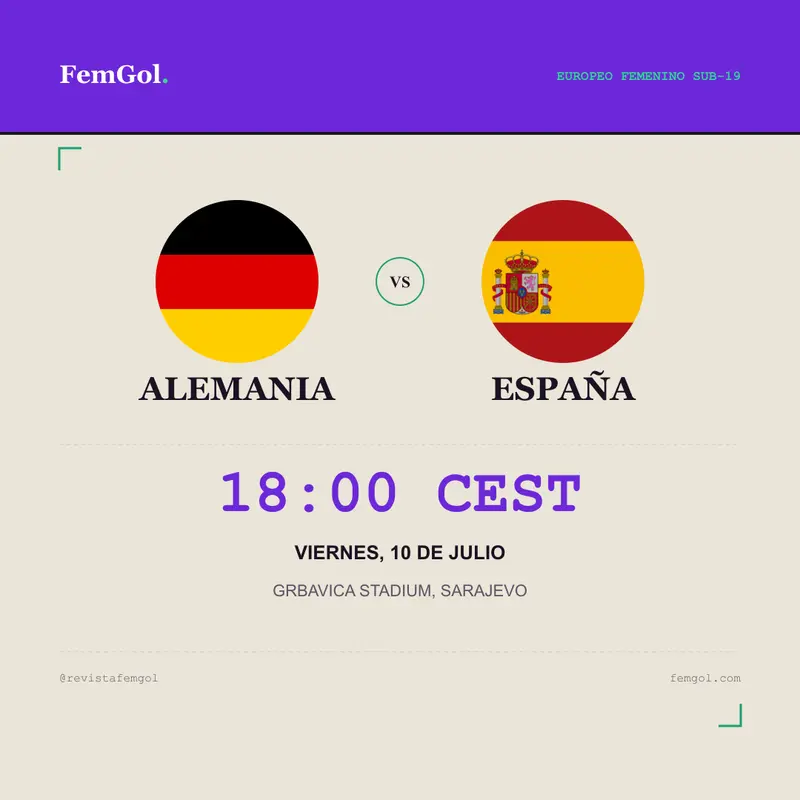
Germany vs Spain Friday 10 July, 18:00 CEST Grbavica Stadium, Sarajevo Live on Teledeporte
Referee: Miriama Bočková (Slovakia) Assistant referees: Aleksandra Mostowska (Poland) and Vasilia Tsiklitari (Greece) Fourth official: Deborah Bianchi (Italy)