Spain do not arrive in Bosnia and Herzegovina to find out how far they can go.
They arrive to defend what they already are.
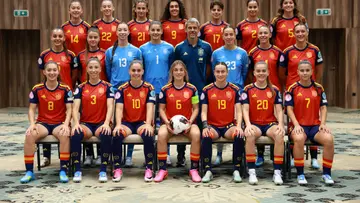
The Spanish side will compete in the Women’s Under-19 European Championship from 27 June to 10 July as holders, winners of the last four editions and the most decorated nation in the tournament’s history.
In any other context, asking a group of 17, 18 and 19-year-olds to compete among the best in Europe would already be a considerable demand. In Spain, they must also live with a word that appears before a single ball has been kicked: the fifth.
The fifth consecutive title.
A possibility that reflects the extraordinary state of Spanish youth football, but also the weight that each new generation must carry. The ones before them did not leave behind only a trophy. They left behind a dynasty.
Eight champions come back to try again
David Aznar will face his first major continental tournament as Under-19 head coach in Bosnia and Herzegovina. Appointed to lead the Under-19 and Under-20 sides in September 2025, he had already taken charge of both qualifying rounds that brought the team here. Now comes the final tournament.
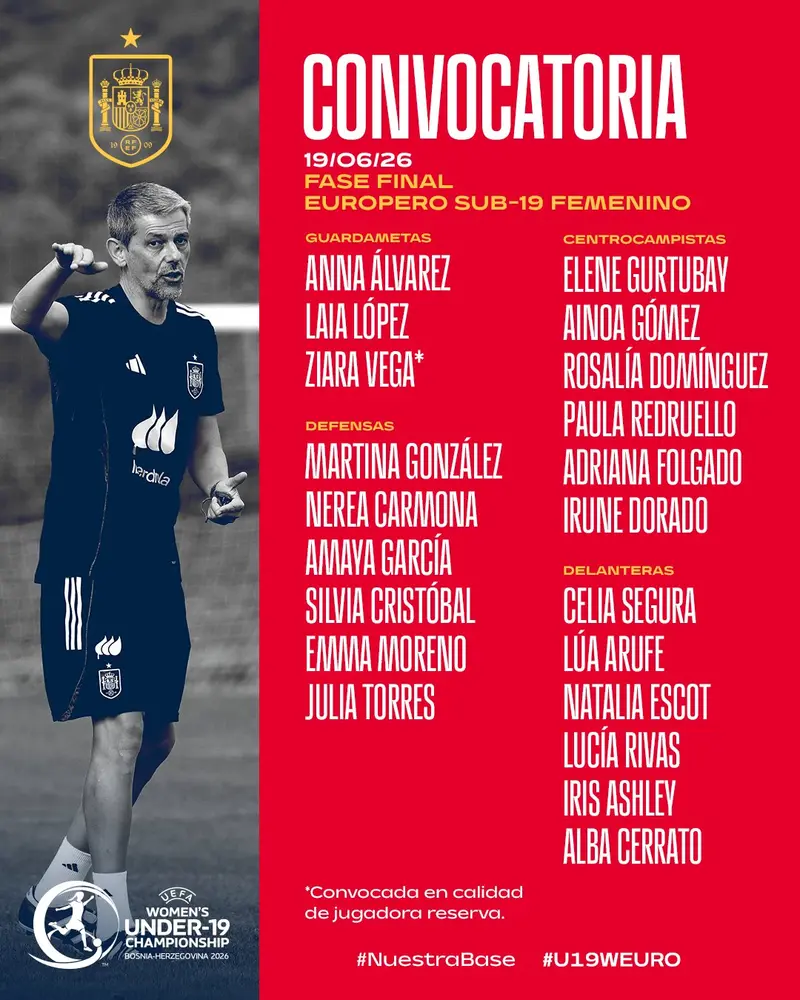
He has selected 20 players, with Ziara Vega included as reserve goalkeeper.
Not all of them are arriving for the first time.
Elene Gurtubay, Emma Moreno, Ainoa Gómez, Celia Segura, Laia López, Amaya García, Irune Dorado and Alba Cerrato were all part of the squad that won the 2025 EURO in Poland. That side finished the tournament with a 4-0 win over France in the final, claiming their fourth consecutive title.
For six of them — Celia Segura, Laia López, Amaya García, Emma Moreno, Irune Dorado and Alba Cerrato — it was not even their first continental celebration: they had already won the Under-17 EURO in 2024.
They are young, but some are already building a trophy record that many complete professional careers will never match. That experience could prove decisive in a short tournament where a single bad performance can end everything. It also means the responsibility does not fall solely on those who have never played in a final tournament before.
A near-perfect qualifying campaign
Spain secured their place in Bosnia after a qualifying campaign in which they scored 24 goals and conceded just one.
In the first round they beat the Faroe Islands 8-0, Belgium 5-1 and Germany 5-0. In the second they defeated Hungary 3-0, repeated that scoreline against Northern Ireland and sealed qualification with a goalless draw against Portugal.
Five wins, one draw and a goal difference of 24 to 1.
Celia Segura was Spain’s top scorer throughout the qualifying campaign, with five goals. The Barcelona forward will be one of the most recognisable names in a squad that retains much of the title-winning structure whilst also including players who will now experience their first Under-19 final tournament.
The numbers make Spain the favourites. They do not hand them any title in advance.
A squad built from the biggest academies
Barcelona and Real Madrid are the best-represented clubs in the squad, with six players each.
From Barcelona come Martina González, Ainoa Gómez, Rosalía Domínguez, Celia Segura, Lúa Arufe and Natalia Escot. Real Madrid contribute Laia López, Amaya García, Silvia Cristóbal, Adriana Folgado, Irune Dorado and Iris Ashley Santiago.
Athletic Club, Deportivo, Sevilla, Levante, Eibar and Ona Sant Adrià are also represented. The make-up of the squad once again shows that the national side draws primarily from the academies of the major clubs — but not exclusively.
Spain’s squad
Goalkeepers
Laia López (1) — Real Madrid CF · Anna Álvarez (13) — Levante UD · Ziara Vega — Athletic Club (reserve)
Defenders
Martina González (2) — FC Barcelona · Julia Torres (3) — Sevilla FC · Silvia Cristóbal (4) — Real Madrid CF · Amaya García (5) — Real Madrid CF · Nerea Carmona (15) — FC Ona Sant Adrià · Emma Moreno (17) — SD Eibar
Midfielders
Irune Dorado (6) — Real Madrid CF · Adriana Folgado (7) — Real Madrid CF · Elene Gurtubay (8) — Athletic Club · Ainoa Gómez (10) — FC Barcelona · Paula Redruello (16) — RC Deportivo · Rosalía Domínguez (22) — FC Barcelona
Forwards
Celia Segura (9) — FC Barcelona · Iris Ashley Santiago (11) — Real Madrid CF · Lúa Arufe (14) — FC Barcelona · Alba Cerrato (19) — Sevilla FC · Natalia Escot (20) — FC Barcelona · Lucía Rivas (21) — RC Deportivo
Switzerland, Iceland and Austria
Spain have been drawn into Group B alongside Switzerland, Iceland and Austria.
They open on 28 June against Switzerland in Sarajevo. The Swiss return to a final tournament for the first time since hosting in 2018 and arrive after an unbeaten qualifying campaign, sealed with a 2-0 win over England.
The second match is on 1 July against Iceland in Zenica. The Icelandic side reached the tournament after edging Denmark by a single point in the second qualifying round.
Spain close the group stage on 4 July against Austria, also in Zenica. The Austrians qualified from an extremely tight group with Scotland and Norway, decided on head-to-head goal difference.
The top two in each group advance to the semi-finals on 7 July. The final will be played three days later at Grbavica Stadium in Sarajevo.
Spain’s schedule
- 28 June — Switzerland vs Spain · Asim Ferhatović Hase Stadium, Sarajevo
- 1 July — Spain vs Iceland · Training Centre FFBH, Zenica
- 4 July — Spain vs Austria · Bilino Polje Stadium, Zenica
- 7 July — Semi-finals
- 10 July — Final, Grbavica Stadium, Sarajevo
When winning stops feeling extraordinary
Spain won their first Under-19 EURO in 2004. It took them thirteen years to lift it again.
Since 2017, however, they have won six of the seven editions played. The most recent title allowed them to surpass several records that had long belonged to Germany: seven titles in total, four in a row, twelve finals contested.
The risk of a run like this is that the extraordinary starts to seem routine. That winning a European Championship gets read as the default. That anything different is treated as failure. That the players are introduced only as the next link in a chain that can never be broken.
But this squad is not an automatic repeat of the ones that came before.
The coach has changed. Many of the key players have changed. Some will be wearing the Spanish shirt in a final tournament for the first time. All of them will need to build their own team before they can try to extend the history they inherited.
A legacy can act as a spur. It can also act as a burden.
They are not only the future
For years, women’s youth football has been told almost entirely in the future tense. The players who will one day make it. The prospects who might be playing at the top level in a few seasons. The names that could eventually appear in the senior squad.
But in Bosnia they will not be competing for what they might become.
They will be competing for what they already are.
Spanish internationals. Champions, some of them. Newcomers, others. Players chosen to represent the most successful nation in the history of the Women’s Under-19 EURO.
Not all of them will reach the senior team. Not all of them will have linear careers. Some will disappear from future squads; others will become familiar names in professional football.
That comes later.
From 28 June, Spain will not only be defending a trophy. They will be defending a way of understanding youth development, a run that has changed the history of the tournament, and the right of a new generation to be something more than the heir to the one before.
The fifth title is within reach.
But first they will have to win it.