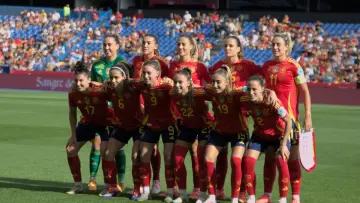
THE OTHER NATIONAL TEAM · ECUADOR
During the men’s World Cup, FemGol will trace the history of some of the women’s national teams from the countries taking to the pitch. Because a country’s football doesn’t fit in a single team.
Tonight, Ecuador face Germany with their place in the World Cup on the line.
The men’s team reach the final round needing to win and to look across at the other match in the group to learn their fate.
Ecuador’s women know that kind of waiting well.
A few weeks earlier, their match had finished, but they were still out on the pitch.
They had lost 0-1 to Argentina in Quito. Samanta Avilés had been sent off in the 77th minute and Florencia Bonsegundo had scored the only goal of the game in the 90+4. The final round of the Nations League had ended for Ecuador in the worst possible way.
And yet the players still could not leave.
Qualification for the World Cup play-off depended on what was happening in Asunción. Paraguay were playing Colombia, and a draw could push Ecuador out of fourth place.
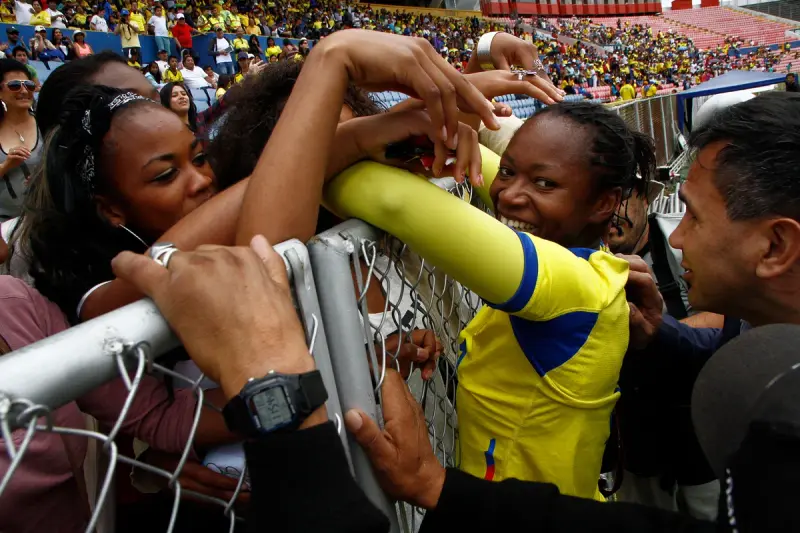
The Ecuadorian and Argentine players stayed on the pitch at the Olímpico Atahualpa, waiting for news.
Colombia won 4-3.
Ecuador had lost their match, but kept the last South American ticket to the play-off. They finished level on eleven points with Peru and went through on a better goal difference: +2 against Peru’s -3.
There was no goal to celebrate, no win to explain the outcome.
Only the confirmation that the World Cup was still possible.
Ecuador already knew that feeling.
The first time, they had waited until the 91st minute.
The first play-off
On 8 November 2014, Ecuador hosted Trinidad and Tobago at the Olímpico Atahualpa.
The Ecuadorian team had finished third at the Copa América played that same year in their own country. Brazil and Colombia took the direct places for the World Cup in Canada. Ecuador had to fight for the last South American chance against the fourth-placed CONCACAF side.
The first leg finished 0-0.
Ecuador attacked, built up chances and repeatedly forced goalkeeper Kimika Forbes into action, but could not travel with an advantage. The tie would be decided on 2 December in Port of Spain.
The return moved towards the same result.
Trinidad and Tobago had chances to score. Ecuador also reached the opposition box, but the ninety minutes were about to end goalless. A draw would send the tie to extra time.
Then came a set-piece.
The ball dropped inside the box and Mónica Quinteros appeared to turn it towards goal. The clock had already passed the 90th minute.
Ecuador won 0-1.
That touch qualified the women’s team for the first World Cup in their history.
In the starting eleven was Ligia Moreira. She was 22 and part of a defence that kept a clean sheet across both legs of the tie.
On the bench was Vanessa Arauz. Months later, at 26, she would become the youngest coach to lead a team at a Women’s World Cup.
Ecuador entered history with a coach almost as young as her players and a goal scored when extra time already seemed inevitable.
Canada did not become a habit
The World Cup immediately showed the distance that still separated Ecuador from the teams used to competing on that stage.
They lost 6-0 to Cameroon, 10-1 to Switzerland and 1-0 to Japan. Angie Ponce scored Ecuador’s only goal of the tournament. The team ended their first appearance with three defeats, one goal for and seventeen against.
The results allow for a simple reading: Ecuador arrived too soon and paid for the gap in level.
But the more important question came afterwards.
Ecuador did not return.
They missed out on the 2019 World Cup in France and failed to qualify for Australia and New Zealand 2023. The team that had needed a stoppage-time goal to get in for the first time could not turn that appearance into a regular presence.
Canada was a peak, but it did not, on its own, create a structure capable of repeating it.
When Moreira recalls her early years as a footballer, she explains that she was studying Journalism, working to support herself and training all at the same time. She did not realise she could make a living from football until she left Ecuador at 26 or 27.
The women’s Superliga did not begin until 2019.
A decade after the World Cup, the picture was different. By early 2025, more than thirty Ecuadorian players were competing at foreign clubs. Some played in Spain, Italy or Mexico; others had found a path to develop in the universities of the United States.
There were more routes than in 2014.
That did not mean the process was finished.
Moreira summed it up before the 2025 Copa América: Ecuador were not short of players, but of continuity in development, better conditions and investment able to sustain them from the youth ranks up.
The World Cup had shown that one generation could get there.
The following decade showed that getting there once did not solve how to produce the next one.
The memory of the first play-off
Ligia Moreira did not stand still across those twelve years.
She played in Colombia and Brazil before building much of her career in Spain. She passed through Real Oviedo, Racing Féminas, Córdoba, Alhama and Fundación Albacete. In June 2025 she signed for Villarreal.
She also opened, with her sister, a football school for girls. They started with eight pupils and, a decade later, were working with more than seventy.
The player who had been part of the first World Cup was trying to build, away from the national team, some of the opportunities her generation had barely found.
Her international continuity was not linear either.
Moreira played the 2025 Copa América as captain, but was left out of the early Nations League squads. Ecuador began the new World Cup road with a younger core and without the player who had symbolised the team for years.
She returned for the final two rounds.
It was not a ceremonial return. Ecuador were fighting for qualification against Chile and Argentina. The team got back a defender who had already lived through a play-off, a World Cup and everything that came after.
When she pulled the shirt back on, the team was once again facing a last chance.
Two matches to save the road
Moreira’s return coincided with another change.
On 31 May 2026, the Ecuadorian Federation announced Eva Espejo as the new head coach. The Mexican coach had led Rayadas de Monterrey to the Apertura 2021 title, becoming the first woman to win the Liga MX Femenil as a head coach.
She took over Ecuador before the two rounds that would decide their World Cup future.
Her debut came five days later in Santiago.
Ecuador beat Chile 1-2. The result moved the team into play-off places before they hosted Argentina on the final matchday.
The win mattered because the earlier campaign had left very little margin.
Ecuador had begun the Nations League with a 0-4 win over Bolivia. They then lost 1-2 to Colombia, drew goalless with Venezuela and Uruguay, lost 2-0 in Paraguay and beat Peru 1-0.
Before travelling to Chile they had eight points.
The win in Santiago lifted them to eleven and let them reach the final round in their own hands. A victory over Argentina would secure fourth place.
They did not get it.
Ecuador held out for more than ninety minutes, played the closing stretch with ten players and conceded Bonsegundo’s goal in stoppage time.
Then the wait began.
The team that had reached its first World Cup by scoring in the last minute came close to losing its second play-off the very same way.
This time it did not need another goal.
It needed Colombia’s.
Eleven points
Ecuador’s qualification was not the product of a dominant campaign.
The team finished with three wins, two draws and three defeats. They scored eight goals, conceded six and ended fourth with eleven points.
Colombia and Argentina took the direct places for Brazil 2027. Venezuela finished third and Ecuador took the last position that led to the intercontinental tournament.
The gap over Peru was nothing more than goal difference.
That margin captures Ecuador’s current place in South America well.
They are no longer the team that reached a World Cup before the creation of the Superliga and with a 26-year-old coach. They have more players abroad, an established domestic competition and footballers building experience in other settings.
But they have not settled in alongside Colombia, Argentina or Brazil either.
Their qualification still depends on tight matches, other people’s results and the smallest of margins. They can beat Chile away and compete for ninety minutes against Argentina, but they can also lose in Paraguay or go several rounds without scoring.
Ecuador have progressed.
The table shows how far they still have to go.
A different play-off
The road to Brazil will not repeat exactly the 2014 tie against Trinidad and Tobago.
FIFA has designed an intercontinental tournament of ten teams and two phases to share out the last three places at the World Cup.
The first phase will be played between November and December 2026 at a centralised venue. Six teams will take part and the two best will advance to the final phase.
In February 2027 they will be joined by four teams seeded directly into that round: two from CONCACAF, one from UEFA and one from CONMEBOL. The six teams will be drawn into three paths, each one granting a World Cup place.
Position in the FIFA ranking will determine which South American representative skips the first phase. Venezuela are currently placed above Ecuador, so the Ecuadorian team cannot count on that privilege before the standings used for the draw are published.
Their likely road will be longer than in 2014.
Back then they needed to win two matches.
Now they may need to survive two phases, and to do it far from home.
They do not yet know their opponents, but they do know the scale of the task: to play the second World Cup in their history, they will have to beat teams from other continents and win when there is no longer another result to wait for.
Twelve years apart
In Port of Spain, Ecuador settled their own fate.
The match was edging towards extra time when Mónica Quinteros appeared in the 91st minute and sent the team to Canada. Ligia Moreira was on the pitch. Vanessa Arauz was directing from the bench. The Superliga did not exist, and very few Ecuadorians could build a career outside the country.
In Quito, almost twelve years later, Ecuador could not settle it alone.
Bonsegundo scored in the 90+4, the players stayed on the pitch and Colombia ended up handing them the result they needed. Moreira was back in the team. Eva Espejo had just taken over the bench. More than thirty Ecuadorian players had recently found opportunities abroad.
Tonight, the men’s team will once again play with their World Cup survival hanging on ninety minutes and on what happens in another stadium.
The women already know that wait.
The destination is the same.
The footballing country that reaches it is not.
The play-off will decide whether that difference is enough.
Canada 2015 showed that Ecuador could reach a World Cup.
Brazil 2027 asks of them something they have not yet managed: to return.