THE OTHER NATIONAL TEAM · TURKEY
During the men’s World Cup, FemGol will trace the history of some of the women’s national teams from the countries taking to the pitch. Because a country’s football doesn’t fit in a single team.
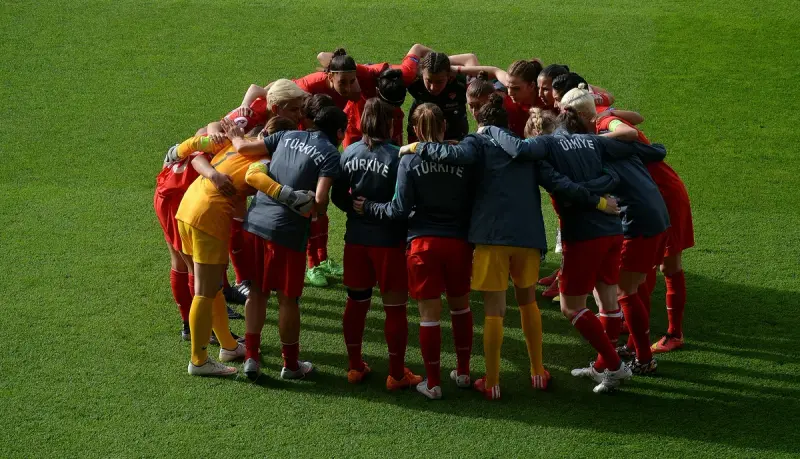
On 31 October 2023, Turkey beat Luxembourg 1-0 in Çorum.
Birgül Sadıkoğlu scored the only goal of the match, in the 14th minute. Two matchdays were still to be played, but the standings could no longer change what mattered: Turkey were group winners and were leaving League C.
They had not earned a place at a Euro or a World Cup. Nor had they beaten one of Europe’s leading sides.
They had gone up a division.
In international women’s football, where every team starts the cycle at a set level and must earn the right to face stronger opponents, that was not an administrative detail.
It was the first step.
Sixteen to nil
The Women’s Nations League began in September 2023 with Turkey placed in League C, Europe’s bottom tier.
Their opponents were Georgia, Lithuania and Luxembourg.
Turkey won all six matches. They scored sixteen goals and conceded none. They won on grounds where they were expected to, settled tight games and finished the group with all eighteen points available.
Promotion was secured against Luxembourg, but Turkey did not stop once they had it. They won their two remaining matches too and completed a perfect campaign.
The figure looked simple: six wins, sixteen goals, none against.
Its real meaning came later.
Going up to League B meant no longer playing only against sides from the bottom of the continent. From then on, every qualifying campaign would force Turkey to face more developed teams, more professionalised squads and players used to competing in Europe’s major leagues.
The reward for winning would be that winning grew steadily harder.
That was exactly what Turkey needed.
Losing higher up
The first test came in qualifying for Euro 2025.
Turkey were drawn with Switzerland, Hungary and Azerbaijan. They could no longer dominate every match or keep a clean sheet. They lost both games against Switzerland and also fell in Azerbaijan.
But they won the other three.
They beat Hungary twice, including a 1-4 win in Győr on the final matchday, finished second in the group and reached the play-offs.
The difference from 2023 was clear.
In League C, Turkey had needed to win to go up. In League B, they could lose three matches and still stay in the fight for a major tournament, because they were also able to beat sides at their own level.
Ukraine were their opponents in the first play-off round.
The first leg, in Istanbul, finished 1-1. Turkey were still alive before travelling to Chișinău, where Ukraine played at home because of the war.
There they lost 2-0.
The 3-1 aggregate eliminated Turkey and closed their road to the Euro in Switzerland. The team was not yet ready to complete the leap.
But they were no longer competing at Europe’s bottom tier.
They had learned to lose higher up.
The player who climbed every step
Ebru Topçu was fifteen when UEFA presented her as one of Turkey’s most promising youngsters before the 2012 Under-19 Euro.
The tournament was held in her own country. Turkey took part as hosts and were making their finals debut at that level.
Topçu was then an attacking midfielder developed at Karadeniz Ereğlispor.
Thirteen years later, in April 2025, the Turkish Federation honoured her for reaching a hundred caps with the national team, by the federation’s own count.
Between those two moments, the level of the opponents changed, the competitions changed, and the club football around the senior side changed too.
Topçu was the top scorer of the Galatasaray side that won the 2023/24 Turkish league, with fifteen goals.
Months later, she scored in the club’s first ever European match, a 4-1 win over Racing Union. Galatasaray then got past BIIK and Slavia Prague to become the first Turkish team to reach the group stage of the women’s Champions League.
Not all the progress happened within the national team.
While Turkey were climbing from League C and starting to play international ties, one of their clubs was reaching Europe’s great showcase for the first time. The players who had to compete against Switzerland, Ukraine or the Republic of Ireland were beginning to gather experiences that had barely existed in the country before.
Topçu does not explain Turkey’s growth on her own.
She has lived through it.
She was the teenager presented as a prospect when a youth finals appearance still seemed an exception. She was later a league champion, a Champions League debutant, one of the national team’s captains and one of the country’s most experienced internationals.
The step they almost lost
Promotion did not turn progress into a straight line either.
In the 2025 Nations League, Turkey competed in League B again, this time against Slovenia, the Republic of Ireland and Greece.
They won both matches against Greece, but lost the four they played against the other two. They finished third with six points.
Two years after leaving League C, Turkey had to play not to go back to it.
Kosovo were their opponents in the relegation play-out. Turkey won 0-4 in Pristina and 3-0 in the return. The 7-0 aggregate kept their place in League B and stopped the first promotion from turning into a round trip.
The ladder also had steps going down.
Turkey had not stopped being vulnerable. They had learned to react before falling.
Thirteen points
Qualifying for the 2027 World Cup in Brazil confirmed that the reaction had been worth something.
Turkey competed in League B once more. Their group was made up of Switzerland, Northern Ireland and Malta.
They started with two wins: 3-0 against Malta and 0-1 in Belfast. Then came a 3-1 defeat in Switzerland and a 1-1 draw against the same side in Sinop.
Switzerland pulled clear at the top, but Turkey never lost control of second place.
They beat Northern Ireland 2-1 and closed the campaign with another 3-0 against Malta. They finished with four wins, one draw, one defeat and thirteen points.
Three years earlier they had piled up eighteen points against Georgia, Lithuania and Luxembourg.
Now they managed thirteen against Malta, Northern Ireland and a Switzerland that had played the last World Cup and hosted the last Euro.
The figure was smaller.
The progress, greater.
Turkey finished second in the group, reached the World Cup play-offs and climbed to 46th in the FIFA ranking — their first appearance among the fifty best teams in the world.
But the European system does not only reward progress.
It also forces you to confirm it.
The ladder changes its angle
The draw paired Turkey with Slovenia.
The tie will be played over two legs in October against a side that has just been competing in League A.
If they go through, their next opponent will be Hungary or the Netherlands.
The name of the Dutch side is a measure of how far the road has changed.
In September 2023, Turkey began their climb facing Georgia.
Three years later, they might have to knock out a European champion and World Cup runner-up to keep their road to Brazil open.
Getting through both rounds does not automatically guarantee a direct place either. Eight teams will win the second tie: the seven best placed in UEFA’s overall standings will reach the World Cup, and the remaining one will have to play the intercontinental play-off.
Turkey are not one match from Brazil.
They are inside the part of the journey where every step forward demands beating someone who started above them.
The next step
Turkey’s men have returned to the World Cup this summer after twenty-four years, though they go out in the group stage.
The women are still chasing the first major senior finals in their history. A history that also included three seasons without a women’s league, between 2003 and 2006, and a senior national team whose activity was interrupted during those years.
It has not arrived all at once. Nor can it be explained by a miraculous generation or a single win.
Their progress can be followed division by division.
First they won every match in League C. Then they finished second in a European qualifying group and played a play-off. Later they came close to dropping back to the bottom tier, defended their place and answered with thirteen points on the road to the World Cup.
Every time Turkey have gone up, the next opponent has been stronger.
In 2023, going through meant leaving behind Georgia, Lithuania and Luxembourg.
In 2026 it may mean getting past Slovenia and then meeting the Netherlands.
The verb is the same.
What has changed is the height.