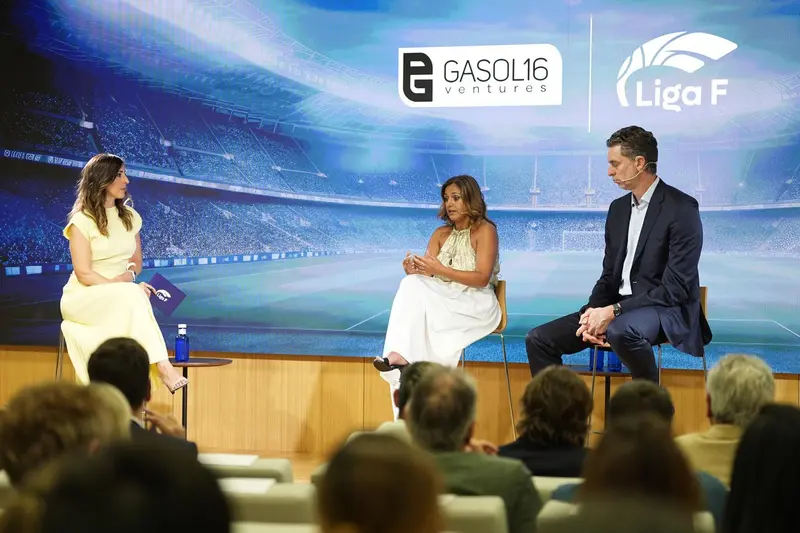
Before the presentation began, the man serving coffee asked Noemí de Miguel why Pau Gasol was appearing alongside the Liga F logo.
The sports journalist, who was hosting the event, explained that Gasol16 Ventures, together with Fortified Partners, was leading a €55 million investment intended to drive the growth of Spain’s top women’s football competition. He then told her about his daughter.
She is eight years old and plays football. Sometimes, he said, the boys do not let her join in because they believe she cannot strike the ball hard enough. Her father tries to teach her other ways of influencing the game: lifting her head, finding the pass, reading what is happening or even going in goal, because he is a goalkeeper himself.
For her, lifting her head is useful for more than simply seeing the pitch.
De Miguel shared the conversation from the stage at the end of the event. The anecdote, chosen to close a presentation filled with figures, commercial plans and institutional statements, contained perhaps the most important question of all: how can a €55 million investment change the football that girl will encounter?
The money will not go directly to her team. The presentation did not announce a specific allocation for grassroots football or a programme designed to intervene on the pitches where girls first begin to play. The investment is focused on Liga F, its central structure and the professional clubs that join the project.
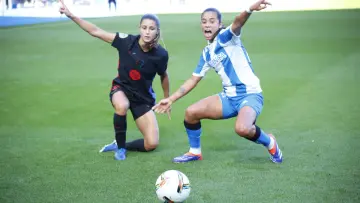
The distance between those two ends of the game is considerable, and the connection is not guaranteed. Liga F and Gasol16 argue that a stronger, more visible and more profitable competition can create better role models, attract larger audiences and help football stop feeling like an exception for a girl.
Four seasons to build a different competition
The €55 million operation, led by Gasol16 Ventures alongside Fortified Partners, will be deployed over four seasons beginning with the 2026/27 campaign.
Liga F presents it as the largest private capital investment yet made in a women’s competition in Europe. Its stated objective is to increase the sporting, media and commercial appeal of both the league and its clubs, while expanding their ability to generate revenue.
The headline figure alone does not explain the project.
During the presentation, Liga F president Beatriz Álvarez identified five main areas of investment: the matchday experience, sporting performance, digital and commercial growth, infrastructure, and the professionalisation of organisational structures and human resources.
On the sporting side, she referred to everything surrounding a footballer: medical services, working methodologies, analysis and specialist staff. At an organisational level, she said the priority was to ensure clubs have teams capable of developing their brands, building relationships with their audiences and generating more income.
The investment will not simply be divided up and handed to the clubs.
Álvarez said Liga F would work with each participating club on programmes tailored to its circumstances, set objectives and monitor whether they were being met. She also warned that having more resources does not guarantee success by itself.
That approach reflects an obvious reality: Liga F’s clubs do not all begin from the same position.
The competition brings together women’s sections operating within major international sporting institutions and independent clubs with far fewer revenue streams, more limited facilities and greater difficulty sustaining their daily operations.
For one club, professionalisation may mean expanding a commercial department. For another, it may begin with hiring medical staff, improving a training pitch or employing more people on full-time contracts.
From stadiums to role models
The matchday experience was one of the most frequently repeated themes.
Liga F acknowledges that regular stadium attendance remains one of its central challenges. Opening major grounds on selected occasions has allowed tens of thousands of people to attend, but the objective is not simply to create one extraordinary day. The competition wants to build loyalty and make attending a match part of people’s routine.
That means working on ticket sales, communication, the experience inside the stadium and the relationship with local communities.
Álvarez also argued that the audience for women’s football should not be understood merely as an extension of the audience that already consumes the men’s game. There is some overlap, but it also includes families, girls and people drawn to a different atmosphere and a different relationship with sport.
That is where the eight-year-old girl re-enters the story.
A stadium with a larger crowd does not directly change what happens at her training session. But it increases the number of people who recognise women footballers, normalises their presence in public life and turns their matches into events a family may want to attend.
Pau Gasol stressed the need to elevate players as role models and tell their stories. He was not speaking only about improving the product on the pitch, but about building recognisable sporting figures capable of reaching families and people who do not yet follow the competition.
Visibility is not a substitute for facilities, coaches or opportunities to play. But it does change the world of references in which a girl begins to imagine herself: the same world that remains incomplete when she opens a packet and finds twenty stickers, not one girl.
When a shirt carries the name of a woman footballer, when a player appears in an advertising campaign or when a match fills a major stadium, playing football stops being something girls do in spite of their surroundings. It becomes a possibility those surroundings recognise.
This is not philanthropy
The presence of a child in the story does not turn the agreement into a charitable project.
Gasol16 Ventures is an investment vehicle. Its public portfolio includes companies in health, technology, performance and entertainment, as well as an investment in the WNBA. In many of those projects, it appears not only as an investor but also as an adviser, contributing experience, visibility and commercial relationships.
Gasol was explicit during the presentation. Investing in women’s sport should not be understood solely as a moral decision or an act of corporate responsibility. It can also be good business.
When asked what Gasol16 would receive in return for the agreement, he declined to disclose the terms but acknowledged that investors were participating with the expectation of generating a financial return.
The logic of the project is precisely to connect social impact with value creation.
Better-known players can attract larger audiences. Larger audiences can increase interest from sponsors and broadcasters. Better-organised clubs can commercialise their assets more effectively. A competition generating more revenue can invest more in its footballers and in the quality of the product.
The circle is coherent. The difficult part will be making it turn — and ensuring that it does not stop at the commercial stage.
What the WNBA can teach
Pau Gasol’s investment in the WNBA offers a useful indication of the model.
In February 2022, the US women’s basketball league completed the first capital raise in its history. It secured $75 million from a group of investors that included Nike, Condoleezza Rice, franchise owners and former athletes such as Gasol.
The intended uses of that money closely resemble the programme now presented by Liga F: marketing, brand development, international expansion, digital innovation, staff recruitment and operational improvement.
It was not simply about financing the competition as it already existed. It was about building the capacity required to generate new revenue.
The league that emerged in the following years looked very different. In 2024, the WNBA recorded its highest total attendance in 22 years, with 2.35 million spectators, a 48% increase on the previous season. Average viewing figures across ESPN platforms reached 1.19 million, up 170%.
That does not mean the capital raised in 2022 caused the growth by itself.
The WNBA’s expansion was also driven by a new generation of players, increased media coverage, the arrival of Caitlin Clark and other sporting and cultural forces. Nor is it publicly known how much Gasol invested individually or what return he has received.
The precedent demonstrates something more limited, but still relevant: a women’s league can attract capital before it has fully developed its commercial potential, use that investment to strengthen its capabilities and find itself managing a far more valuable product several years later.
That appears to be the opportunity Gasol16 sees in Spain.
Gasol also referred to his involvement in Bay FC, the National Women’s Soccer League franchise that began competing in 2024. Sportico estimated its value at $121 million in September of that year and $208 million in March 2026.
That trajectory reinforces the same thesis: invest early in women’s sports properties with room to grow their audiences, sponsorship income and media rights. But a valuation is not the same as a realised profit, and neither the size of Gasol’s investment nor the extent of his stake is publicly known.
Liga F is also a different type of operation. It is not a new franchise or a conventional equity stake in a single company, but a competition made up of clubs with different interests, resources and operating models.
How the promise will be measured
Capital can hire professionals, improve facilities, develop campaigns and allow a club to build in four years what might otherwise have taken ten.
But money cannot replace management. Nor can it change a culture by itself.
The eight-year-old girl will still need a team that welcomes her, someone to coach her, a pitch on which to play, a family able to take her there and an environment that does not constantly force her to justify why she wants to take part.
A stronger Liga F can help create that environment. It can give her role models, make her teammates familiar with women footballers and demonstrate that women’s football is not a temporary activity.
To know whether the promise reaches her, more than revenue will need to be measured.
It will be necessary to see whether regular attendances increase, rather than only crowds at major occasions. Whether clubs create stable structures. Whether conditions improve for players. Whether footballers become recognisable public figures. Whether talent is retained. And whether opportunities expand for the generations coming next.
It will also be necessary to know what the investors receive in return, what obligations the clubs assume and how compliance with each programme will be assessed. Those terms were not explained in detail during the presentation.
When the man serving coffee understood what was being presented, he said his daughter would be delighted.
Her excitement does not depend on understanding the financial architecture of the agreement. It is enough for her to hear that the football she wants to play matters enough to receive a €55 million investment.
But the responsibility of Liga F and its investors begins after that emotion.
The measure will lie in the connection between those two worlds: whether improved stadiums produce larger crowds; whether those crowds turn players into role models; whether those role models encourage more girls to play; and whether, in a few years’ time, an eight-year-old girl needs fewer strategies and fewer arguments before she is allowed into the game.
The €55 million begins in Liga F.
The promise is that its effect will not end there.