Fifty-five million euros already have a headline. The agreement that should explain them is not yet public.
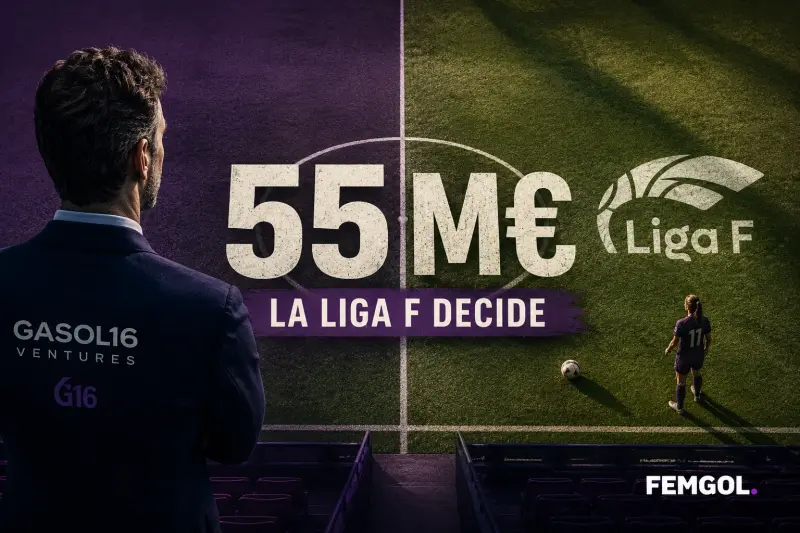
Liga F clubs meet this Monday in an extraordinary general assembly to vote on the investment proposal led by Gasol16 Ventures, the business vehicle of Pau Gasol, alongside other investors whose identity has not been disclosed.
The operation aims to bring 55 million euros to the competition and its clubs in order to professionalise its commercial model, accelerate its internationalisation and consolidate a long-term growth project.
According to Liga F, it would represent the largest private investment ever received by a women’s football league and one of the most significant in the history of professional women’s sport.
The figure is public. Its duration, distribution, investor returns and the rights attached to the operation are not.
What is being put to a vote
Liga F made the proposal public on 16 June. Its statement explained that the investment would target the commercial development of the competition, its international positioning and the construction of a long-term growth model for the league and its clubs.
Gasol16 Ventures maintains that it does not intend to contribute capital alone. The company also aims to make available its network of commercial and institutional relationships and the knowledge accumulated by Pau Gasol throughout his playing career and subsequent business activity.
Gasol has experience as an investor in women’s sport in the United States, both in the WNBA and at Bay FC of the NWSL. That track record helps to understand the value Liga F may find in his involvement: not just a sum of money, but an internationally recognised figure connected to brands, investors and markets the competition is still trying to reach.
None of that, however, allows us to anticipate how the Spanish operation would work in practice.
The statement also does not clarify whether the clubs will be voting on the definitive acceptance of all conditions, authorisation to continue developing the agreement, or approval of a preliminary structure ahead of its formalisation.
That distinction matters. Approving a closed contract is not the same as granting a mandate to continue negotiating within agreed limits.
What has not been explained
The announcement tells us the size of the proposal, but not its architecture.
It has not been communicated how long the 55 million euros would be disbursed over, nor how the money would be distributed: what share would go directly to clubs, how much would fund Liga F’s own structure, and what resources would finance the competition’s commercial and international development.
An investment also implies an expectation of return. The participants are not handing over 55 million euros without expecting some form of compensation — but what that compensation would be has not been explained.
We do not know whether they would receive a share of future revenues, rights over certain assets, a stake in a company, an agreed fee, or any other form of remuneration. Nor is the identity of the investors accompanying Gasol16 Ventures known.
The fact that these conditions are not public does not necessarily mean that the clubs are unaware of them.
Liga F’s statutes establish that the notice of an assembly must be accompanied by the documentation necessary to deliberate on the items included in the agenda. Where justified urgency prevents this from being sent with the notice, the information must be made available to members before the meeting.
The lack of information is public, not necessarily internal.
How many votes does the proposal need?
Liga F has not officially communicated the majority required to approve it either.
Its statutes establish simple majority as the general rule: a resolution passes when it receives more votes in favour than against among the members present.
However, certain decisions require the backing of two thirds of those present. These include the authorisation of contracts that commit the organisation for more than two seasons and whose consideration exceeds 20% of an exercise’s budget.
The duration of the proposal and its contractual structure are not publicly known. It therefore cannot be determined from the outside whether the operation falls under that provision or any other requiring a qualified majority.
The minutes of previous assemblies also show that major economic decisions within Liga F have not always generated consensus.
In June 2024, the budget for the 2024/25 season was approved with eleven votes in favour, five against and two abstentions. Real Madrid and Barcelona formally registered their votes against, though for different reasons.
The Madrid club questioned the level of certain expenditure and what it considered a lack of transparency surrounding bilateral contracts between Liga F and some clubs. Barcelona criticised the budget’s lack of coherence and ambition and the distribution of audiovisual rights.
The precedent illustrates that disagreements exist over Liga F’s economic model and governance. It does not, however, allow us to predict the position of any club on the Gasol16 proposal.
The unanswered question: how does it fit with LaLiga?
The investment does not arrive into a commercial vacuum.
Since August 2022, LaLiga has acted as the exclusive commercial agent for Liga F’s own commercial and sponsorship rights and assets. The agreement covers, amongst other items, the main sponsor, the official match ball, official agreements and the competition’s licences.
The contract guarantees Liga F minimum revenues of 42 million euros and covers at least five seasons, from 2022/23 to 2026/27. It does not include audiovisual rights, which were commercialised through a separate process.
The Gasol16 Ventures proposal also lists commercial development of the competition among its objectives. That makes it essential to know when the new project would begin.
If the operation were to be deployed before the end of the 2026/27 season, Liga F would need to explain how it would coexist with the current contract and which assets would fall under each arrangement. If it were to begin afterwards, Gasol16 may be positioning itself to build the competition’s next commercial cycle.
2Playbook has raised the possibility that the investor group could take over from LaLiga as the competition’s commercial partner. For now, this remains a possibility reported by that outlet, not a condition confirmed by Liga F or Gasol16 Ventures.
The relationship between the two agreements is therefore one of the key questions the competition will need to clarify after the vote.
The assets that do not belong to Liga F
A further question concerns the rights of the clubs themselves.
Liga F’s statutes establish that the individual commercial assets of each entity — their brands, symbols, image, advertising and their own commercial capacity — belong to their owners. No club is obliged to transfer them to Liga F unless a statutory norm requires it.
The public announcement does not allow us to know whether the proposal contemplates the inclusion of any of those assets in the Gasol16 Ventures project. If so, the consent of each rights holder would be required.
Approval of the proposal would therefore not automatically mean that all sixteen clubs’ commercial rights become part of the operation.
A competition that already has something to sell
The proposal arrives after four seasons in which Liga F has built an economic structure that did not previously exist.
The competition has long-term audiovisual and commercial agreements, a main sponsor, its own licences and distribution mechanisms for its clubs.
According to an analysis of its accounts by 2Playbook, Liga F generated around 15.6 million euros in ordinary revenues during the 2024/25 season. When subsidies, institutional agreements and other contributions are included, its total operating revenues came to approximately 25.8 million.
These are not two different ways of measuring the same thing. The first figure reflects the ordinary revenues generated by the competition’s own activity. The second shows all resources managed during the financial year, including those that still derive from grants and institutional agreements.
Liga F also reported distributing 17 million euros among its clubs during that season.
From 1 July, a new system for distributing revenue from football sports betting will come into effect, allocating 15% to Liga F. The final amount will depend on total receipts and must be directed primarily towards obligations under the coordination agreement with the RFEF and the collective bargaining agreement.
The competition continues to depend in part on institutional resources, but it is no longer a structure without assets or revenues of its own. It has contracts, audiences, rights and growth potential. That is precisely what explains why private capital has begun to look at it differently.
The 55 million euros are not arriving to keep something alive that does not exist. They are arriving because there is already a product whose value may increase over the coming years.
The question is how that growth will be shared, and what stake those who finance it will receive.
Gasol’s value beyond the figure
Pau Gasol’s involvement gives the proposal a dimension that exceeds the announced sum.
His name brings international recognition, access to business and sporting networks, and experience as an investor in women’s sport in the United States. That relational capital may help open markets, attract international brands and improve Liga F’s external positioning.
But the investor’s name does not substitute for the terms.
The quality of the operation will depend on its duration, the commitments made, how the money is used, the agreed returns and the mechanisms that protect the interests of the competition and its clubs.
It will also depend on whether the commercial growth reaches the players, the professional structures, the stadiums and the product that supporters receive.
What will need to be explained afterwards
The outcome of the assembly will be news, but a yes or a no will not be enough to understand what has taken place.
If the clubs approve the proposal, Liga F will need to explain exactly what has been authorised, what the next step will be and which elements of the agreement can be made public.
It will be necessary to know how long the 55 million euros will be deployed over, how they will be distributed, who the other investors are, what return they will receive and how the project will fit with LaLiga and the existing commercial contracts.
It will also need to be clarified what majority backed the decision and whether the vote represents the definitive approval of the operation or the beginning of a new phase.
If the proposal does not pass, the rejection should not automatically be read as opposition to private investment. It could reflect disagreements over the distribution, duration, rights requested, asset valuation, returns or any other condition we do not yet know.
This Monday, the clubs will decide on what Liga F describes as the largest private investment ever received by a women’s football league.
The figure is already public.
After the assembly, the agreement that gives it meaning should begin to be so as well.