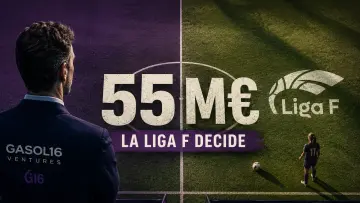
Before anyone was prepared to put 55 million euros on the table, there was a weekend when the footballers decided not to play.
On 16 and 17 November 2019, eight matches were scheduled for the ninth matchday of the Primera División. Not one of them was played.
The players went on strike after more than a year of negotiations without agreement on the first collective bargaining agreement for the division. They were demanding a minimum wage, limits on part-time contracts, regulated holiday entitlements, protection during sick leave, maternity rights and basic working conditions for a competition that already required them to behave as professionals.
That strike did not bring a professional league to a halt.
It was not one yet.
Professionals inside a competition that was not
That was the contradiction underpinning the top tier of Spanish women’s football.
There were professional players, internationals, daily training sessions, travel, physical demands, sponsors and televised matches. There were historic clubs, stadiums that were beginning to fill on special occasions and a national team that was starting to occupy more space.
But the competition remained embedded in the federation’s structure and had no legal recognition as a professional league.
Women’s football could grow in audience, raise its sporting level and produce images of packed stadiums. Yet it still lacked a shared structure capable of negotiating its rights from its own position, building a common brand and guaranteeing that every player started from basic working conditions.
The 2019 strike turned that contradiction into something impossible to keep ignoring.
The first collective agreement was signed on 18 February 2020 and published months later in the Official State Gazette. It established a guaranteed minimum of 16,000 euros gross per year for full-time players and capped part-time contracts at 75 per cent of the standard working day.
That figure did not make the players privileged. It did not even guarantee that all of them could live comfortably from football alone.
But it introduced something that had not existed before: a floor.
For the first time, the top tier of Spanish women’s football had a collective labour framework that acknowledged that behind every match there were workers — with hours, wages, rest periods, holidays, sick leave and rights.
The legal professionalisation of the competition had not yet arrived. The labour one had begun to make its way from below.
Recognition came later
On 15 June 2021, the Consejo Superior de Deportes approved the professionalisation of the women’s Primera División unanimously.
The decision did not create professional women’s football. It officially recognised something that players had been demonstrating on the pitch and demanding off it for years.
Nor did it automatically produce a new league.
Statutes had to be agreed, the relationship with the Royal Spanish Football Federation had to be defined, governing bodies had to be established and an organisation had to be built capable of taking on functions that had not previously existed independently.
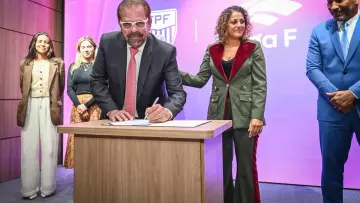
The statutes of Spain’s first professional women’s league were approved in March 2022. Liga F was born as its own entity and began organising the competition from the 2022/23 season.
Spain had a professional women’s league.
That did not mean it had a wealthy one.
Building a product that had previously been scattered
Professionalisation gave the new Liga F a decisive capability: turning the whole competition into a product.
Until then, the value of Spanish women’s football was fragmented. Each club had a different economic reality, different commercial capacity and its own relationship with its men’s section, where one existed. The visibility of a match could depend as much on its sporting interest as on who held its rights or decided to produce it.
A professional competition needed more than good teams.
It needed a shared identity, matches broadcast to minimum production standards, sponsors for the competition as a whole, rules for distributing income and a structure capable of sitting down to negotiate on behalf of all its participants.
In August 2022, Liga F reached an agreement for LaLiga to handle the commercialisation of its sponsorship and commercial assets for at least five seasons. The contract guaranteed a minimum of 42 million euros, excluding audiovisual rights.
A few weeks later came the new competition’s first major television deal.
DAZN acquired the global and exclusive rights for 35 million euros over five seasons. The Gol channel secured the free-to-air match each matchday and highlights. For the first time, every match in the top tier of women’s football could be watched live under a jointly managed commercial arrangement.
That cycle was due to end in 2026/27, but Liga F put it back on the market early and, four years on, no bid reached the price it was asking.
Liga F was beginning to do something that men’s football had been doing for decades: packaging its competition, selling it and distributing the money generated.
A market had been born.
Professionalisation also needed public money
That market did not emerge on its own.
Creating an organisation, producing audiovisual content, adapting facilities, hiring staff and improving clubs’ structures all required resources before the new competition could generate its own.
The Consejo Superior de Deportes committed 20 million euros over the first three seasons to launching and sustaining Liga F. Around a further 20 million were added to improve clubs’ infrastructure.
Public backing was not a secondary detail. It was part of the founding model.
The professionalisation of women’s football had been presented as a matter of justice, but turning that recognition into a real competition had a cost. Someone had to finance the transition from the old Primera División to a league with its own staff, television production, institutional obligations and a shared commercial strategy.
That is why the early years of Liga F cannot be explained solely as a story of commercial growth.
They were also a public investment to correct a historical inequality and build the conditions from which a sustainable business might one day exist.
First, something had to be created that could later be sold.
Having contracts did not mean the economics were resolved
The first professional season delivered important contracts, sponsors and unprecedented visibility. It also made clear that the word “professional” did not on its own resolve the problems that had come before.
The competition’s first main sponsor ended up in litigation over a payment dispute. The institutional relationship with the Federation produced clashes over responsibilities and costs. Clubs continued to operate from very different economic starting points.
And the players went on strike again.
The start of the 2023/24 season was marked by a fresh strike — this time within a fully professional Liga F. The dispute again centred on the minimum wage.
The agreement reached set a progression of 21,000 euros for 2023/24, 22,500 for the following season and 23,500 for 2025/26. Depending on the growth of the competition’s commercial revenues, that final figure could rise to 28,000 euros.
The formula contained all the economic tension of the new competition.
Players were demanding guaranteed labour rights. Clubs responded that improvements had to be matched to their capacity to generate income. Liga F’s commercial growth had entered directly into the collective bargaining agreement.
The debate was no longer simply about whether women footballers should be recognised as professionals.
It was about how much Spanish women’s football could realistically pay — and how what it was beginning to produce should be shared.
From recognition to distribution
Over its first seasons, Liga F built a structure that had not previously existed.
It sold its audiovisual rights centrally. It brought in sponsors and licensing deals. It created distribution mechanisms between clubs. It established funds linked to relegation. It increased match production and built a commercial identity for the competition.
In the 2024/25 season, the organisation distributed 17 million euros among its clubs. Total competition revenues had grown from 18 million euros in the first professional season to 22.8 million the following year and 25.8 million in 2024/25. The cumulative television audience reached 6.7 million viewers — a 90 per cent increase on the previous season.
The figures were still far below those of the major men’s competitions and did not remove the dependence some clubs maintained on their parent organisations. Nor did they on their own correct the enormous gap between the highest-budget clubs and those that had to weigh every investment.
But they showed that there was already something to distribute.
That is the fundamental difference between the league that went on strike in 2019 and the one that reached the end of the 2025/26 season.
The first was demanding minimum conditions to be able to call itself professional.
The second had already created audiovisual contracts, commercial assets, an income structure, a recognisable brand and an expectation of growth.
It still needed support. It still carried unresolved conflicts. It still had to demonstrate that it could turn visibility into a stable economy for all its clubs and players.
But it had stopped being only a cause that needed to be financed in the name of justice.
It was also beginning to be an asset.
The end of the beginning
Liga F’s first years were funded, in large part, to build.
To build an organisation. To build television production. To build facilities. To build a brand. To build a labour framework. To build the possibility of selling jointly something that had previously been scattered.
Professionalisation did not immediately turn Spanish women’s football into a profitable business. It turned it into a competition capable of trying to become one.
That was the objective of the first phase.
Liga F already had television, sponsors, commercial income, its own structure and clubs receiving a growing economic share. It had demonstrated that interest existed. What it had not yet resolved was how to finance the next step without remaining permanently dependent on the money that had allowed it to build the first.
The question had changed.
It was no longer how much it cost to keep women’s football alive.
It was how much it could be worth.
Then someone put 55 million euros on the table.