When Spain played their first Women’s European Championship in 1997, Añorga KKE had already won six national titles.
It was not a section attached to one of the big men’s clubs. It was the team of a cultural and sporting association from a neighbourhood of San Sebastián.
Its honours, though, matched anyone’s: three Copas de la Reina and three league titles won in barely seven years.
The history of Spanish women’s football was written there too.
Five cup finals in seven years
The first Copa de la Reina final recognised under that name by the Royal Spanish Football Federation was played in 1989. Parque Alcobendas beat Añorga 4-1 in Logroño.
The defeat did not close off an opportunity. It opened an era.
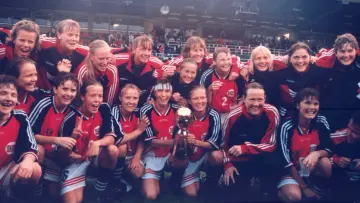
Between 1989 and 1995, Añorga played in five of the seven cup finals and won three of them. They were champions in 1990, retained the trophy in 1991 and won it back in 1993.
The federation itself describes that period as an era shaped by the Basque club. No other side appeared as often in the finals of those seven years.
Añorga had not appeared from nowhere. They had already been national runners-up in 1984 and 1987, but in the 1990s they turned that consistency into trophies.
And while they were dominating the cup, they also began winning the league.
A league season without defeat
The 1991/92 season ended with the first league title in Añorga’s history.
The competition was made up of eight teams and each played fourteen matches. The San Sebastián side won thirteen and drew one. They finished on 27 points, when a win was still worth two, and became the first unbeaten champions of the Spanish top flight.
The title came between the second and third Copa de la Reina. In four seasons, the club had lifted four national trophies.
Then came two years of league dominance from Oroquieta Villaverde. Añorga responded by taking the title back in 1994/95 and retaining it in 1995/96.
Those two consecutive league titles completed the tally: three cups and three league championships between 1990 and 1996.
Spain had still not taken part in the final stage of a European Championship or a World Cup.
Arantza del Puerto, the thread running through it all
One player connects all six celebrations.
Arantza del Puerto began playing for Añorga at nine years old and stayed at the club for 25 seasons. She was the defensive anchor of the side that won the three cups and the three leagues.
She was also one of the most important Spain internationals of her generation, winning 71 caps between 1990 and 2005.
In 1997 she was part of the squad that travelled to Norway and Sweden for Spain’s first European final tournament. The team came through the group stage and reached the semi-finals.
By then, Del Puerto had already lived through her club’s entire golden era.
Her career helps measure what Añorga meant. Before Spanish women’s football had a professional league, before its first World Cup and even before the national side reached a European Championship, a player could grow up, compete and complete 25 seasons at the same neighbourhood club.
A club that kept producing players
The titles of the 1990s are not Añorga’s only mark.
Its academy kept turning up in the careers of new internationals. Nahikari García played there between 2008 and 2014. Nerea Eizagirre joined Real Sociedad from Añorga. Amaiur Sarriegi also came through the club, and has recalled that as a girl she would go down to watch its senior teams play.
They are different generations, but they belong to the same line.
Añorga were champions when the women’s elite was still made up of small associations, independent teams and sections working far from the spotlight. Afterwards it went on giving players somewhere to start.
That is why its six titles are not a footnote to the story built around the big clubs. They are part of the main history.
By the time Spain reached a European Championship for the first time, that team from a San Sebastián neighbourhood had already won everything there was to win in their country.