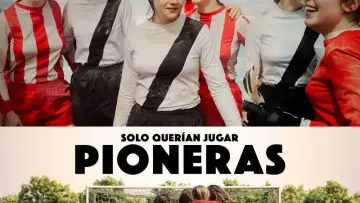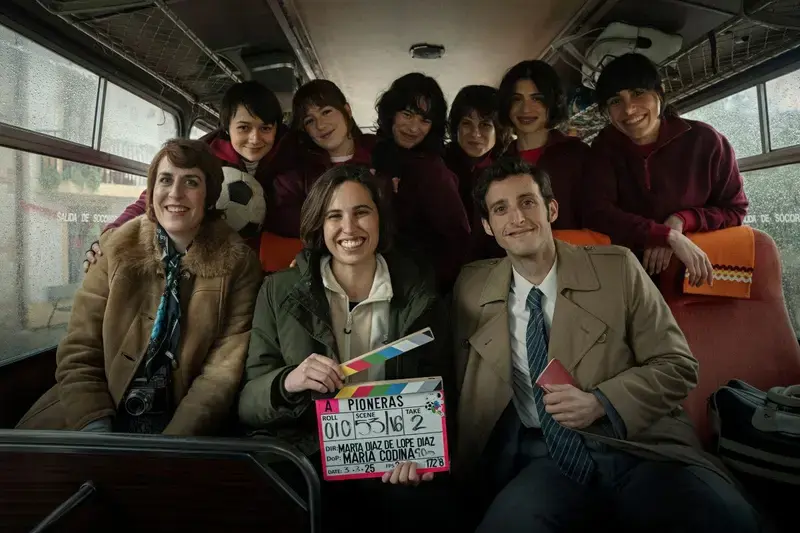
When Marta Díaz de Lope Díaz began work on Pioneras. Solo querían jugar, she knew she was holding a complex story. A sports film that could not speak only to football fans. A story about women, shot through with politics and with rights won in the face of those determined to keep them at the margins. A tale that also had to acknowledge the role of a man without letting him take ownership of a story that was never his.
“We knew we were working with flammable material,” the director admits.
But the film also ended up opening a door Marta perhaps had not expected. As a girl she played football in the school playground. She was the only one. Then she stopped playing, and even stopped watching football. What she found years later, while piecing together the story of those pioneers who faced a far more hostile Spain, she tells in her own words near the end of this conversation.
The legacy of these pioneers has gained renewed public interest following the recent viral appearance of Carmen Arce ‘Kubalita’ and María Ángeles Pérez ‘Quilla’ on the popular Spanish TV show La Revuelta with David Broncano, where they recalled the mud and struggles of playing in the 1970s. This conversation connects directly with the themes Marta Díaz de Lope explores in her film.
On the eve of the release of Pioneras. Solo querían jugar, which arrives in cinemas this Friday, Marta Díaz de Lope talks to FemGol about the memory of women’s football, the violence of some of the NO-DO newsreel footage, the film’s delicate balancing act and the story she would have loved to see when she was twelve or thirteen.
Interview lightly edited for readability.
The impact of film vs. sporting success
—Almost three years after you started the project, are you ready for the opening whistle?
—I am, yes. The truth is I’m very happy. We’re proud, in a way, of the film we’ve made. I’m nervous about the release, really looking forward to people being able to see it, and hoping they’ll take the plunge and go to the cinema.
It’s been three years since we started writing it. For a film, that’s really not that long. It’s probably the fastest film I’ve ever made. But the whole thing has flowed. We can’t wait to release it now, and we’re thrilled that people will finally get to see it.
—The film arrives at a moment when women’s football has grown enormously. Spain have been world champions, Liga F has an ever bigger presence, and we are beginning to recover the memory of those left out of the story for decades. But sporting success only lasts as long as the news cycle. What can a film offer that a victory on the pitch cannot?
—When we started thinking about the film, even before writing it, I thought a lot about whether it made sense to make it and release it now. We started in 2023, and just as we began writing it, they won the World Cup.
From what I’ve researched and from the people we’ve spoken to along the way, the answer really is yes: I think it was important to make this film — accepting, obviously, that there are far more important things in the world.
Women’s football is at a point where the talent that was always there is finally being recognised — talent that never had the opportunity, the structure or the spotlight that would have allowed it to flourish.
I think it’s good to look back and see where we’ve come from, the whole journey that, starting with these women in the early seventies, has brought us to where we are now.
Obviously, the difference is enormous. But beyond football, the film is precisely about the role of women in those early seventies. I think it’s a story that can travel across many generations. Not just that of those women in the final years of Franco’s regime. I grew up in the nineties hearing “marimacho” — the slur thrown at girls who played like boys; I grew up in a school playground where I was the only girl who played football.
So yes, I do think it makes sense for it to be seen now, at this moment.
The gaze of the NO-DO vs. the modern camera
—During your research you found NO-DO footage that looked at the players’ bodies in a deeply degrading way. Then you had to place your own camera in front of other players. Did you consciously think about where to put it so as not to repeat that gaze?
—Honestly, that footage was so appalling, so unsubtle, that there was never any danger of me doing anything like it. It’s unthinkable.
Several of the most significant NO-DO reels I found are in the film, especially towards the end. And even more than the images, it was the commentary that was truly humiliating — deeply sexist — and it captures the gaze of the era.
I think it also captures the intention that existed at the time to sink — though it may sound like a strong word — women’s football; to keep it as something purely anecdotal, a circus act, something at the margins.
This was a moment when there was a hugely important battle with the Federation to get it recognised in some form. And I think that gaze of the NO-DO journalists carried a great deal of spite.
There was one shot we also put in the film because we felt it mattered: a shot that simply panned across the girls’ backsides. Or questions in the dressing room that had no place there, like whether they would marry a footballer or which of them was the better cook.
That footage was among the first things I saw when I was told about the story of these pioneers. And I really did say: “There’s something here, clearly.” It felt like another planet. And it wasn’t that long ago: not even sixty years, as of now.
Balancing characters: the role of the promoter
—You’ve made a sports film without speaking only to football fans; you address women’s rights and politics without turning the film into a pamphlet; and you give Javier Poga a prominent position within a story that still belongs to the pioneers. Did you ever think you were wading into too many minefields? Is Marta Díaz de Lope a woman with a death wish?
—Well, we knew we were working with flammable material. We were aware of that.
The figure of Javier Poga was thorny, obviously. But he was very real. Javier Poga, Daniel Ibáñez’s character, is inspired by Rafael Muga, the young promoter who, in a way, stood alongside these girls and made it possible for them to play. He was the one organising the matches; he tried to put together the first Spanish national team and took on the Federation.
What I mean is: if the girls were very young and not fully aware of what they were doing meant, he certainly was. And that was a reality.
For us it was very important to strike the balance: for Javier Poga’s figure to have the place he genuinely had — because denying it would be absurd — and for it to be understood that there really were men, or young people, already living in a Spain more advanced than the one around them, or in the Spain that was to come; but always conscious that the soul of the film was the girls.
I think you can see it clearly in the film: he manages to make things happen, in a way, but the soul of the film, what stays with you, is these pioneers. It was a difficult line to walk.
—Now a slightly selfish question. I’m a man trying to run a women’s football publication. Javier Poga has to learn to accompany a story that isn’t his. What advice would you give to men who want to support this cause without occupying the space they’re trying to open up?
—I’ll say this first: I’m nobody to be giving advice. But I will say that all the men who want to help… As I said in other interviews: “We won’t move forward by women becoming more feminist; we’ll move forward by men becoming less sexist.” There’s something in that.
So I would encourage — and in fact applaud — men like you, or like Rafael Muga, not overthinking it beyond the fact that these girls had to play, played well, and why on earth shouldn’t they play.
There’s a slightly naive quality to his gaze that I find really beautiful, because it wasn’t shaped by the prejudices of the time. I’m talking about the real person. And about the character we created too, because in the end there’s an element of fiction.
But what I’d say is what I say to my friends and the people I talk to: obviously, we need men. Of course there are plenty of men who aren’t sexist. We grew up in years that are not today. Bit by bit — well, depending on the context — the way people see things is opening up.
So let the evolution come from everyone.
Reconnecting with childhood and past sacrifices
—After living with this story for three years, is there anything you’ve learned from those women that you’ll carry with you long after the release? Has the Marta who started the film changed at all?
—Yes, truly. Every film makes you grow enormously, professionally and personally.
Professionally, this film has pushed me a long way, because it’s a complicated film with a lot of challenges. I was facing things very different from anything I’d done before, and I’m taking away lessons about everything: the way of shooting, the people I’ve worked with, the film itself. I think I keep learning more each time.
And then, personally, it has helped me too. I loved playing football when I was little, as I told you, at school. But I stopped playing and I stopped watching football. Almost like a small trauma — I abandoned it completely.
The film has helped me reconnect deeply with that girl and with everything I loved back then; and with how, because I couldn’t do it, it became the first thing I ever had to give up, when I was very young.
So it’s as if a little stone has been taken out of my shoe and, in a way, I’ve made the film I would have loved to see. At twelve or thirteen I would have been delighted to watch a film like this.
I think that has been very important for me, personally and professionally.
Historical memory: from cinemas to classrooms
When Marta finishes answering, a possibility emerges that goes beyond the box office: that Pioneras. Solo querían jugar might not merely recover a story, but also reach those who are still building their own.
Perhaps the film Marta would have loved to see at twelve is also a film that deserves to be shown in schools today.
"That wouldn't be bad at all," the director replies. "You're not the first person to say so, and honestly, it could well be an interesting initiative."
This country has come a long way, and there is still much to do — and not only on equality. But one thing is fundamental: not forgetting our history. For those of us born after Franco's regime, it can be hard at times to grasp where we come from and what our mothers and grandmothers lived through. Films that honour the pioneers — women and men — who set in motion, each in their own field, the changes we enjoy today should not be forgotten. They should be taught.
The film Marta couldn't watch at twelve arrives in cinemas this Friday.
If you want to continue reflecting on the importance of role models in childhood, we invite you to read: Twenty stickers, not one girl.