ON THIS DAY · 18 JUNE 1995
It was raining on the Råsunda Stadium when Hege Riise picked up the ball near the German box.
It was the 37th minute of the 1995 World Cup final. Riise drove forward, left a rival behind and struck with her left foot. The shot skidded across the wet turf, beat the goalkeeper and finished by the post. Norway were ahead of Germany.
Three minutes later, Marianne Pettersen threw herself in among several defenders to bundle home the second goal. She was 20 years old. Germany still had the whole second half ahead of them, but the Norwegian side had already reached the place towards which it had been walking for four years.
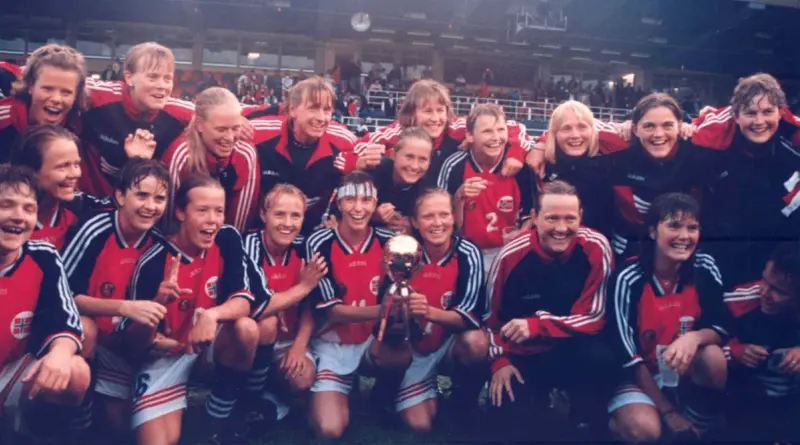
When the match ended, the scoreboard still read 2-0. Norway were world champions.
They had not won by holding on for ninety minutes or surviving a penalty shootout. They had reached the final after scoring 21 goals in five matches and had just beaten the European champions clearly. The 1995 World Cup was not the story of a small nation that seized an opportunity: it was the story of a team that arrived convinced it was the best and spent two weeks proving it.
The defeat that began to build the champions
Four years earlier, Norway had played in the final of the first Women’s World Cup officially organised by FIFA. The United States won 2-1 in Guangzhou with two goals from Michelle Akers. For the Norwegians, that defeat meant falling one step short of the first great world title in the history of the game.
But the team did not break up after that final. Even Pellerud stayed on as head coach, much of the group remained together and went on accumulating experience in an era when international women’s football was still building its competitions and its place within the federations.
Norway had already been European champions in 1987, and won the continental title again in 1993, beating Italy in the final. By the time the 1995 World Cup in Sweden came round, this side was no exotic outsider or Scandinavian surprise: it was one of the strongest teams on the planet. The players arrived in the best physical shape of their careers and with a shared feeling: out on the pitch, nothing seemed able to stop them. The tournament confirmed that this confidence was not arrogance. It was information.
Seventeen goals before conceding the first
Norway were drawn in a group with Nigeria, England and Canada. Their first match finished 8-0; the second, 2-0; the third, 7-0. Three games, three wins, seventeen goals scored and none conceded.
Pellerud’s team could attack in many ways: the finishing of Ann Kristin Aarønes, Riise’s intelligence in midfield, the experience of Linda Medalen and a defensive structure led by Gro Espeseth. It did not need to monopolise the ball to dominate; it could press, attack at speed, look directly for its forwards and turn second balls into fresh chances. The football was intense, vertical and collective, and every player seemed built to amplify the strengths of the others.
Denmark managed to score against them in the quarter-finals. They were the only side to do so in the entire World Cup. Norway won 3-1 and reached the semi-finals with twenty goals for and only one against.
Waiting there were the United States.
Beating the team that had taken the World Cup from them
The match against the United States was no ordinary semi-final: it was the reunion with the side that had beaten Norway in the 1991 final. The Americans were defending the title and fielded players such as Michelle Akers, Mia Hamm and Carin Jennings.
Norway went ahead with a header from Ann Kristin Aarønes and then had to hold on. The United States pushed in the closing minutes and even struck the woodwork —“in the final minutes I think they hit the crossbar three times,” Aarønes would recall—, but the ball did not go in. The match finished 1-0.
Norway could not recover the final they had lost four years earlier. But they could stop the United States from defending their title. The scorer of the winning goal would end the tournament with six and take the Golden Boot as top scorer: Aarønes was a forward who was extremely hard to contain, powerful in the air and able to turn any ball into the box into a threat.
But to reduce that Norway side to its physique would be to misunderstand it. The heart of the team was Riise.
Hege Riise, the football before the football
Hege Riise did not need to run faster than everyone else because she usually understood sooner what was about to happen. She would receive, lift her head and find the next pass. She could join the attack, organise the press or slow the rhythm when a match began to break up.
Norway were a direct side, but not a basic one: they needed a player able to connect the team’s power with an idea. That player was Riise, and in Sweden she produced the best tournament of her career. “It was, without any doubt, the best moment of my career,” she would say herself. FIFA recognised her with the Golden Ball as the World Cup’s best player; Gro Espeseth received the Silver Ball as the second best, and Aarønes added the Golden Boot to her six goals. The tournament’s major individual prizes stayed, almost as a block, in the Norwegian dressing room. The ceremony only confirmed what had happened on the pitch: the World Cup had belonged to Norway.
Germany never gave up
The final was played on 18 June 1995 in Solna. Germany arrived as recent European champions —they had won the continental title just three months earlier— and were, moreover, a particularly painful opponent: in the two previous European finals, those of 1989 and 1991, they had thrashed Norway by an aggregate of 7-2.
The match began under steady, driving rain that turned every touch and every turn into a small risk. But Norway did not lose their shape. In the 37th minute Riise appeared: after a dribble that left the defence behind, she scored from outside the box with a curling shot. It is one of only two goals ever scored from outside the area in the history of Women’s World Cup finals —the other, Carli Lloyd’s from the halfway line in 2015—. It was the goal of the tournament’s best player in its most important match.
Three minutes later came the second. Marianne Pettersen attacked a ball inside the box and got there before the German defence to slide it home. At 20 years and 67 days, she became the youngest scorer in a Women’s World Cup final, a mark that still stands.
Norway went into the break two goals up and did not celebrate too soon: they knew Germany all too well. They defended the lead to the end and kept a clean sheet. After six matches, the balance was almost absurd: six wins, twenty-three goals for, one against, the United States and Germany both eliminated, and a World Cup.
The champions come home
Back home, Norway received those footballers as what they were: world champions. “We even had two military planes flying alongside ours to escort us back to Norway, where there was a big celebration at the airport,” Riise would recall years later to FIFA. They were returning with the first World Cup won by a European side and with one of the greatest sporting titles in the country’s history.
The achievement was all the more extraordinary given Norway’s size. The United States and Germany had far larger populations, structures and resources. The Scandinavian country had built, through continuity, development and an exceptional generation, a team capable of beating them.
And it would not be their last great success. At the Sydney 2000 Olympic Games, Norway beat the United States again and took gold, becoming the first women’s team to hold the world, European and Olympic titles. Between 1987 and 2000 they won four major championships. It was not a fleeting appearance: it was a dynasty.
Before Hegerberg and Graham Hansen
Today, Norwegian football is associated with names like Ada Hegerberg, Caroline Graham Hansen, Guro Reiten or Frida Maanum: some of the best players of their generation, at the most powerful clubs in Europe. But they are the continuation of a story, not its beginning.
Before there were big contracts, packed stadiums or millions of people following women’s football, Norway had already built a champion side. The 1995 generation did not have the exposure of today’s professionals —their World Cup featured only twelve teams and was played when the tournament was still seeking its place— but those players were not primitive versions of the current ones. They were the best of their time. Riise, Aarønes, Espeseth, Pettersen, Medalen and their team-mates did not win because women’s football was less developed: they won because, within that football, no one could match them.
The world belonged to Norway
Thirty-one years have passed since that rainy afternoon in Solna. Norway have not won a major tournament since the Olympic gold of 2000: other structures grew, new powers emerged and the centre of gravity of women’s football shifted towards countries able to invest far more.
But no later evolution can diminish what was achieved in Sweden. Norway arrived at the 1995 World Cup with the memory of a lost final, a coach with six years of continuity and a generation that had learned to compete together. They left without dropping a single point, having scored 23 goals and conceded one.
For two weeks, a small country played as if size did not matter. And for two weeks, they were right.
Final and tournament details via Wikipedia and FIFA; Pettersen’s youngest-scorer record and Riise’s goal from outside the box from FIFA’s final-in-stats feature; Norway’s honours via UEFA.