The official story is not wrong. It is incomplete.
The Estadio Azteca is back at the centre of world football. There will be talk of 1970, of Pelé rising above the Italian defence and of a Brazil side that still serves as the measure of beauty. There will be talk of 1986, of Maradona, and of a ground that needs no introduction because it has spent decades accumulating other people’s memories. It will be repeated that this is the first stadium to host three men’s World Cups.
All of that is true.
But there is a date that rarely appears when the Azteca’s memory is recited: 5 September 1971.
That day, more than 110,000 people filled its stands to watch a final between Mexico and Denmark. There were no men on the pitch. Nor was it an exhibition match or a warm-up act placed before the main event. It was the final of a women’s World Cup organised outside the structures of FIFA.
Denmark won 3-0. All three goals were scored by a fifteen-year-old forward named Susanne Augustesen.
Then the story disappeared.
Also on FemGol: Mexico are playing too: the women’s side chasing a World Cup return after twelve years
A World Cup before World Cups existed
Precision matters. The Mexico 1971 tournament was not a World Cup recognised by FIFA. It is best described as an unofficial women’s World Cup, so as not to manufacture a comfortable version of the past. The first FIFA-organised edition would arrive twenty years later, in China, in 1991.
But the word unofficial cannot be allowed to become an elegant way of diminishing it either.
A year earlier, another international tournament billed as a World Cup had been held in Italy. Mexico picked up the baton in 1971 and took the idea to another scale. Six national teams took part: Mexico, Argentina, England, France, Italy and Denmark. There were matches in Mexico City and Guadalajara. There were rivalries, tension, thrashings, a bad-tempered semi-final between Mexico and Italy, and a host nation capable of drawing a multitude to the Azteca.
It was not the first time women had played football. Nor was it the first time they had drawn a crowd. The history of women’s sport is full of earlier moments that were treated as anomalies so that nobody had to accept they belonged to a tradition.
But Mexico 1971 has something that is hard to dodge: its size.
It is difficult to present a stadium with more than 110,000 people inside it as an anecdote.
Everything was already there
The images from that tournament are disconcerting because they do not look like the precarious infancy of a sport still asking permission to exist. They look like a World Cup.
The players appeared on television and in the newspapers. There were sponsors, posters, official programmes, badges, keyrings, stickers and shirts. Every squad had an interpreter and training facilities. When some of the teams landed in Mexico, they found cameras, fans and the kind of reception usually reserved for stars.
The championship even had a mascot: Xóchitl, a Mexican girl drawn with a ball in her hands. Her name means flower in Nahuatl. She appeared on pennants, medals, leaflets and all manner of promotional products. Before many federations had fully accepted that women could occupy a football pitch, someone had already understood that they could occupy a shop window too.
It should not be romanticised.
The tournament was not a feminist utopia ahead of its time. Much of its promotion leaned on the very stereotypes it claimed to challenge. There were goalposts painted pink, beauty salons beside the stadium, and coverage that frequently looked at legs before it looked at the game. The players were athletes and, at the same time, a product presented as an exotic novelty.
That contradiction does not reduce the importance of what happened. It makes it even more revealing.
Spectacle football had discovered the commercial value of the women’s game before the institutions were prepared to recognise its sporting value.
A shop window without wages
While the sponsors filled the hoardings and the publicity machine turned the tournament into an event, the protagonists were still not being paid.
The Mexican players considered refusing to play the final. They had filled stadiums, filmed advertisements and fed a business growing all around them, yet they received nothing of what they were generating. According to the press of the day, they demanded two million pesos for the squad. The organising committee refused. The protest drew criticism and public pressure. In the end, they played.
“We were never paid for playing in the World Cup,” Alicia Vargas, the forward Mexico nicknamed la Pelé, would conclude decades later. The closest thing to compensation came when it was all over: on 11 September, six days after the final, Mexico and Argentina returned to the Azteca for the Copa Xóchitl, a benefit match organised to raise funds for the families of the Mexican players.
The story of Lourdes de la Rosa, one of the youngest members of the host squad, captures with almost painful precision the distance between the glitter and the reality. Years later she told El País that, despite playing matches, attending promotional events and filming advertisements, they were never paid. On one occasion a businessman handed each of them 500 pesos. She was 17, and she used the money to buy a pair of trainers, some trousers and a bottle of Chanel No 5.
Outside there were more than 110,000 people.
Inside the dressing room, they were still debating whether the players deserved to be paid.
Three goals and a teenager
On 5 September, Mexico took the field carried by a country that wanted to celebrate its footballers. Denmark had other plans.
Susanne Augustesen scored in the 28th, 42nd and 51st minutes. She was fifteen. She had needed her parents’ permission to travel, and she ended up scoring a hat-trick in a final played in front of one of the largest crowds ever to witness a sporting event starring women.
The image of the Danes lifting the trophy at the Azteca should occupy a recognisable place in football culture. Not because it is necessary to invent a perfect genealogy connecting that tournament directly to everything that came afterwards. History rarely moves in a straight line.
It should occupy that place because it happened.
Because thousands of people bought a ticket.
Because the stands were full.
Because women’s football was not waiting for someone to discover its potential. It was demonstrating it.
How to erase a full stadium
The disappearance of Mexico 1971 cannot be explained by poor memory alone.
The tournament was played outside the official structures and found no continuity. The institutions that controlled football did not fold it into their story. In some countries, taking part had consequences. The members of the England squad — remembered today as the Lost Lionesses — came home after playing in front of multitudes and were sanctioned for having attended an unauthorised competition.
For decades, some of those footballers barely spoke about what they had lived through. Not because the Azteca had been empty. Precisely the opposite: because it was hard to explain a gigantic experience when the official history insisted it had barely existed.
The documentary Copa 71, directed by Rachel Ramsay and James Erskine, recovered footage that had sat in archives for half a century and gave many players back the chance to see themselves on the pitch. Its greatest contribution is not merely rescuing a fascinating curiosity. It forces a change of question.
The question is no longer why women’s football took so long to wake up.
The question is what happened every time it woke up and someone decided to switch the light off again.
Pioneers do not appear when we discover them
The story speaks naturally to what was happening in Spain during those same years. Here, too, there were women who played before they were recognised, full grounds that were later cropped out of the frame, and narratives built as if every generation had to start from zero.
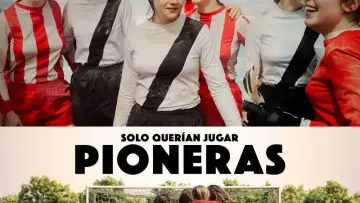
The film Pioneras. Solo querían jugar recovers part of that memory: that of the young women who cleared a path in a country still debating whether running after a ball was an appropriate activity for them. The stories are not identical. They do not need to be.
They share an uncomfortable question: how many times can a sport be born before we decide to remember the people who were already there.
Also on FemGol: Pioneras: before football looked at them, they were already playing
The empty page
For years it was repeated that women’s football needed time. That it had to grow. That before claiming space it had to prove there was an audience willing to watch.
The phrase keeps reappearing in different forms. Sometimes when kick-off times are discussed. Sometimes when television rights are negotiated. Sometimes when patience is demanded of people who have spent decades being told the right moment has not yet arrived.
Mexico 1971 does not settle every present-day debate on its own. It does not prove that any match will fill any stadium. It does not erase the economic gaps, nor does it allow a simple story of inevitable progress.
It does something more useful.
It makes it impossible to pretend the question had never been answered.
When the Azteca fills again and the cameras sweep its stands, there will be talk — justly — of the men who turned that turf into sacred footballing ground. It is worth keeping a space, too, for the women who played there in front of more than 110,000 people and then had to wait more than half a century to recover their place in memory.
The stadium was not empty.
It was the page that was left blank.