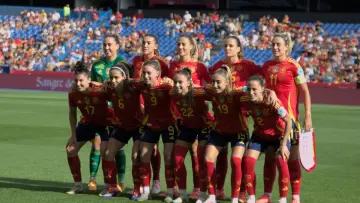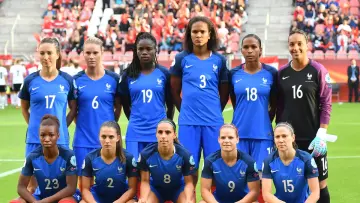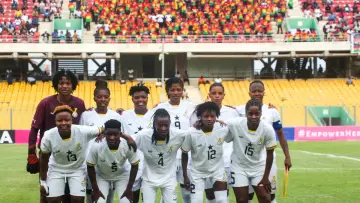
THE OTHER NATIONAL TEAM · UNITED STATES
During the men’s World Cup, FemGol will trace the history of some of the women’s national teams from the countries taking to the pitch. Because a country’s football doesn’t fit in a single team.
The United States has hosted a men’s World Cup hoping to confirm that soccer now occupies a stable place within the country’s sporting culture. For weeks, stadiums across the nation have filled to watch a team still searching for the deep international run that would place it alongside the game’s historic powers.
This instalment of The Other National Team, however, will be different from almost all the others.
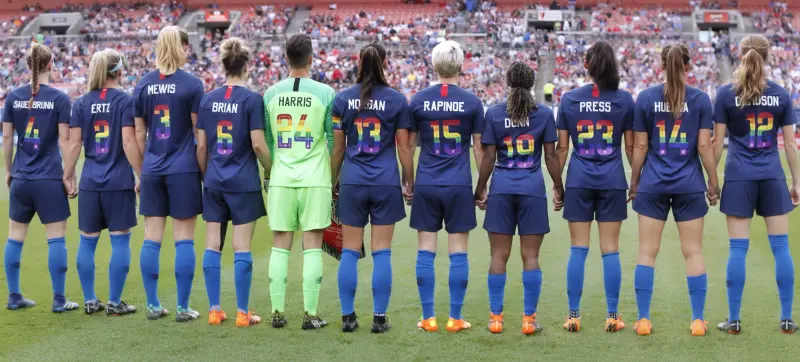
There is no need to discover the United States women’s national team or to reconstruct in detail a history already summarised by the four stars above its crest. The United States won the World Cups of 1991, 1999, 2015 and 2019 and spent decades as the dominant force in the women’s game.
That is why the national team will consciously remain in the background here. Not to diminish its importance, but because that importance no longer needs to be proved.
The question lies beneath its titles: what kind of footballing nation made so much success possible?
When the headline of this story speaks of soccer and football, it is not describing two different sports. It is describing two different ways of building the same game.
Across much of the world, organised football grew around clubs, competitions and spaces designed by and for men. Women had to demand a place much later within structures that had never been created with them in mind.
American soccer followed a different path.
It did not grow only around major clubs or a century-old men’s tradition. It spread through schools, universities, municipal parks, community leagues and families looking for a sport for their sons and daughters.
Within that landscape, women’s football did not necessarily emerge as a late extension of the men’s game. It was able to develop an ecosystem of its own.
The difference began to take shape in 1972.
That year, Title IX came into force, a federal provision of just 37 words prohibiting sex discrimination in education programmes receiving federal funding. The law was not written specifically for sport, but it transformed the opportunities schools and universities offered women.
Soccer fitted particularly well into that transformation.
It allowed institutions to form large teams, could be played within the education system and gave universities a women’s competition with room to grow. While the major American professional sports remained associated almost entirely with men, soccer became one of the areas in which institutions could expand their sporting opportunities for female students.
The national team came later.
The United States did not play their first official women’s international until August 1985. All 17 players selected for that tournament in Italy had come through college soccer. The NCAA had only begun officially recognising its women’s championship three years earlier.
Before there was a great national team, the educational structure that would sustain it was already being built.
Four decades later, that structure remains vast.
During the 2024/25 academic year, 393,048 girls played soccer across 12,516 American high schools. By participation, it was the country’s third-largest girls’ high-school sport, behind only outdoor track and field and volleyball. In the same year, another 31,200 players competed within the NCAA.
Those numbers explain something that can be difficult to understand from outside the country.
In many places, a girl who wanted to play football had to enter a space already understood as male. She had to find a team willing to accept her, train alongside boys, justify her presence and live with the suspicion that she was playing a sport that did not belong to her.
In the United States, millions of girls grew up seeing soccer as one of the activities available at school or in their community. It was not unusual for a girl to play. She did not first need to see a professional stadium before imagining herself on the pitch. She could look to an older sister, a classmate or a university student.
That did not turn the United States into a society without inequality or make prejudice disappear. But it changed the original question.
For many girls, it was not “Will they let me play football?” but “Which team am I going to play for?”
That was where soccer surpassed football.
Not because it attracted more spectators than the NFL, the NBA or the country’s major professional leagues. Nor because every female player could make a living from it.
It surpassed football because it made normal something the traditional game had treated as exceptional for far too long: a girl occupying a pitch without needing to ask permission.
The national team was the most visible result of that normality.
The generation that won the 1991 World Cup did not emerge from an established professional league. Its players came through the college system. The team of 1999 turned that structure into a national event. The final against China drew 90,185 people to the Rose Bowl and ended with Brandi Chastain’s winning penalty, a celebration that left the sports pages and entered American popular culture.
Mia Hamm, Michelle Akers, Julie Foudy and Chastain were not merely admired by people who followed soccer. They became some of the most recognisable athletes in the country. Abby Wambach, Megan Rapinoe, Alex Morgan and later generations preserved that connection.
For years, the greatest American figures in football were not men.
That changes a country’s relationship with a sport. While the men’s national team was still trying to establish its place in a market dominated by other competitions, the women’s team could stand as one of the country’s finest sporting representatives on the world stage.
But reducing this story to four World Cups would once again confuse the outcome with its origin.
The importance of women’s football in the United States is not found only in the players who reached the national team or in those whose goals and celebrations became recognisable images across the country.
It is also found in all those who played without becoming professionals, in those who found a team at high school or an opportunity at university, and in the generations who grew up understanding that a football pitch could belong to them too.
That is what distinguishes the United States from most of the countries explored in this series.
In other instalments, the men’s national team must be moved aside for a moment to reveal that the women also exist, also compete and also have a history.
In the United States, the opposite is true.
The women’s national team does not need to be discovered. What often remains hidden is everything beneath its titles: an education law, thousands of schools, universities that created teams and a culture in which seeing a girl play stopped being an exception.
The United States did not dominate women’s football simply because it found the best players.
It found them because it had first built millions of places where they could begin.
And it was there, long before the first star, that soccer surpassed football.