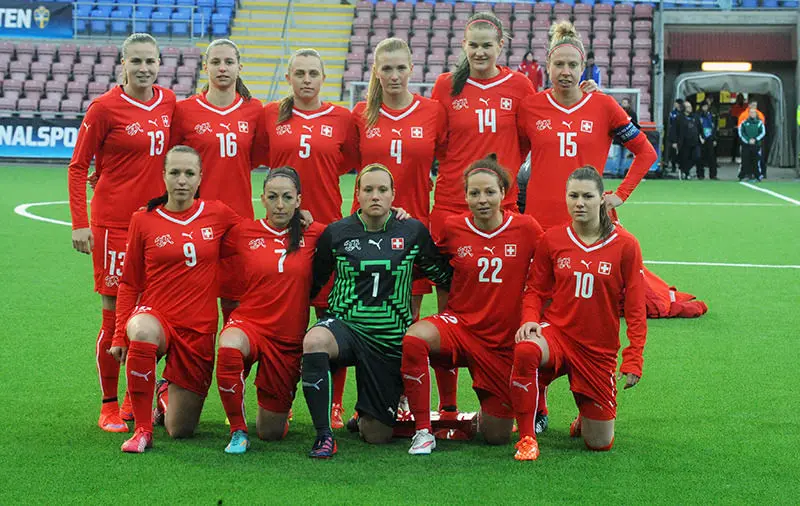
THE OTHER NATIONAL TEAM · SWITZERLAND
During the men’s World Cup, FemGol will trace the history of some of the women’s national teams from the countries taking to the pitch. Because a country’s football doesn’t fit in a single team.
Switzerland return to action in Vancouver today. After defeating Algeria 2-0, the men’s national team face Colombia for a place among the final eight at the World Cup.
The story of their other national team can also be told through a door that appeared to be closed.
The first time a girl received a football licence in Switzerland, it happened by mistake.
The player who was not supposed to be there
Madeleine Boll was 12 years old and trained with Sion’s youth team. In 1965, the Swiss federation mistakenly issued her with a player’s licence and allowed her to compete for the club.
The licence gave her access to a space the regulations had not reserved for her. Boll played for Sion’s youth team in the preliminary match before a European fixture between the senior side and Galatasaray. Her presence attracted the attention of the international press.
That was when the federation noticed its mistake.
It withdrew her licence and explained that only male players could be registered. Madeleine had become the first licensed female footballer in the country and also the first to lose that licence for being a girl.
The decision kept her out of official competition. It did not close the path she had just revealed.
Building a league without waiting for permission
Madeleine Boll was not alone.
FC Goitschel, one of the country’s first women’s teams, asked the federation for permission to play official matches. The request was rejected. As an alternative, the institution offered to train the players as referees.
Fourteen accepted.
They were not allowed to take part in the matches, but they could learn how to officiate them.
The players eventually organised outside the main football structure. They contested a first unofficial championship in 1969 and, on 24 April 1970, founded the Swiss Women’s Football League in Bern with ten clubs.
Full integration into the Swiss federation did not arrive until 1993. Twenty-eight years had passed since Madeleine Boll’s licence was withdrawn.
A World Cup 45 years later
The existence of a competition did not guarantee immediate development.
Switzerland opened its first dedicated training centre for girls in 2004. The senior national team had to wait until 2015 to qualify for a World Cup for the first time.
They reached the round of 16 in Canada. During the group stage, Switzerland defeated Ecuador 10-1 and Fabienne Humm scored three times in five minutes, the fastest hat-trick in the history of the competition.
Switzerland returned to the World Cup in 2023. They finished top of their group, ahead of Norway and co-hosts New Zealand, and once again reached the round of 16. Spain, who would go on to become world champions, ended their run.
The national team had established its place at the major tournaments. It had still never progressed beyond the group stage of a Women’s EURO.
To do so, Switzerland had to play at home.
Madeleine returned as Maddli
The mascot of Women’s EURO 2025 was a St Bernard puppy named Maddli.
The name was a tribute to Madeleine Boll.
Sixty years after the federation withdrew her licence, that girl had come to represent the biggest women’s football tournament ever staged in Switzerland. Maddli appeared alongside the teams, travelled between the host cities and welcomed a generation that no longer needed an administrative mistake to find its place in football.
The hosts lost their opening match against Norway, then defeated Iceland and entered the final group game needing a result against Finland.
Switzerland were trailing 1-0 when Riola Xhemaili equalised in added time. Her goal sent the team into the quarter-finals of a Women’s EURO for the first time.
The tournament also produced an image that went beyond the results. A crowd of 34,063 attended Switzerland’s opening match in Basel, at the time a record for the women’s national team. Before the game against Iceland, 14,000 supporters walked together through the streets of Bern towards the stadium.
Spain eliminated Switzerland in the quarter-finals, but the barrier had already been broken.
Back in League B
The success of the EURO coexisted with a less encouraging reality.
One month before the tournament, Switzerland had been relegated to League B of the Nations League after finishing bottom of their group with two points. In November, the federation decided not to renew the contract of Pia Sundhage, the coach who had led the team through that historic home tournament.
Her replacement was Rafel Navarro. The Catalan coach arrived after six seasons as an assistant at Barcelona and signed a contract until 2029. The federation asked him to build a style based on technique, creativity and collective intelligence.
Switzerland responded by winning their World Cup qualifying group with 16 points from a possible 18. First place secured promotion back to League A and allowed them to enter the play-offs as a seeded team.
They will face Israel in October. If they advance, they will play Kosovo or Austria for a place at Brazil 2027. The seven highest-ranked winners from the second round will qualify directly for the World Cup, while the eighth will enter the inter-confederation play-offs.
In 1965, Madeleine Boll entered official Swiss football because someone made a mistake.
When the federation discovered that she was a girl, it withdrew her permission to play.
Sixty years later, her name travelled through the stadiums of a Women’s EURO as Switzerland reached the quarter-finals for the first time.
The road now leads to Brazil.
This time, Switzerland do not need anyone to make a mistake before letting them in.