THE OTHER NATIONAL TEAM · SOUTH KOREA
During the men’s World Cup, FemGol will trace the history of some of the women’s national teams from the countries taking to the pitch. Because a country’s football doesn’t fit in a single team.
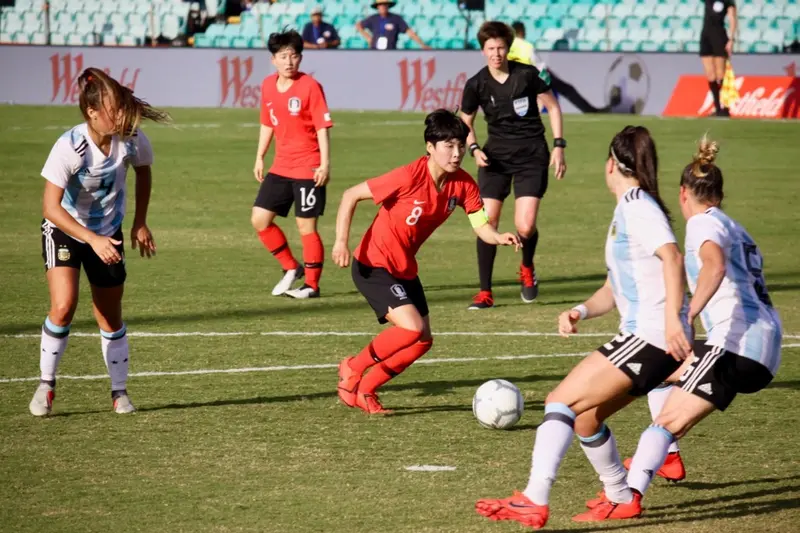
South Korea does not need to be introduced as an emerging team. That moment has already passed. It reached the round of 16 at the 2015 World Cup, spent years competing among Asia’s stronger sides and, in 2023, left behind an image that was hard to forget: a draw against Germany that was not enough to get out of the group, but did help push a former world champion out of the tournament.
That detail explains quite well where South Korea stands. It does not always have enough to write its own story to the end, but it still has enough football to change other people’s.
South Korea showed that again at the 2026 Asian Cup. It drew 3-3 with host nation Australia and still finished top of its group on goal difference. It thrashed Uzbekistan in the quarter-finals and sealed its ticket to the 2027 World Cup in Brazil. Then Japan arrived and reminded it that the Asian ceiling remains one step higher. The 4-1 defeat in the semi-finals did not erase the journey, but it did define the problem: South Korea competes, resists, shows up — but it does not yet dominate.
At the centre of that story is Ji So-yun. Not just as an important footballer, but as a kind of living memory of Korean women’s football. For years, she was proof that the country could produce top-level talent. Her career in Europe, her influence within the national team and her return to Korean football turned her into more than a midfielder: she became the bridge between what South Korea wanted to be and what it could actually sustain.
But bridges age too.
The question around South Korea now is not whether it has a past. It does. Nor whether it has a future. Casey Phair appeared at the 2023 World Cup at 16 years and 26 days old and became the youngest person ever to play at a senior World Cup, men’s or women’s, even ahead of the men’s record held by Norman Whiteside, who played for Northern Ireland in 1982 at 17 years and 41 days. Her name arrived the way promises sometimes do: with noise, with excitement and with a responsibility that perhaps should not be placed on a teenager.
Because Phair is not a solution. Not yet, at least. She is a sign.
Her emergence suggests that South Korea can keep producing talent, even a different kind of talent, shaped between several worlds and ready to grow outside the traditional path. But it also reveals something else: the national team needs more than isolated names. It needs a generation that does not depend on a legend refusing to fade or on a young player being asked to skip stages.
That is the uncomfortable point. For years, South Korea has been good enough not to disappear, but not strong enough to finally break through its ceiling. It has had players, it has had moments and it has had matches that force you to look at it with respect. What it has not always had is enough continuity to turn all of that into a winning identity.
The problem is not only on the pitch. In September 2025, the players issued a joint statement with their union: they threatened to boycott training sessions and matches before the Asian Cup if the federation did not respond by 17 October to their complaints about bus travel and economy-class flights, accommodation far from training grounds and out-of-pocket costs for transport and equipment. Behind it was one figure: the federation allocated less than 10% of the men’s team budget to the women’s team. The dispute was resolved weeks before the tournament, when the KFA committed to paying for business-class flights on all long-distance trips for the women’s national team from then on. This is not an administrative detail. For a team living on fine margins, worse travel, less rest and poorer preparation also become football.
That is why South Korea does not quite fit the comfortable story of a “team on the rise”. Growth sounds linear, almost inevitable. This feels more like a wait. The wait for talent to find structure. For the league to offer more support. For the transition between generations not to feel like a leap into the void. For Ji So-yun to become less indispensable without that feeling like an irreparable loss.
The 2027 World Cup will offer another opportunity. South Korea will not arrive as a favourite, but nor will it be there just to make up the numbers. It will arrive with experience, with memory and with a question still unanswered: whether this time the future will be a team, or just another individual name.
Because South Korea has already learned how to be there. Now it has something harder to learn: how to truly stay.