THE OTHER NATIONAL TEAM · NETHERLANDS
During the men’s World Cup, FemGol will trace the history of some of the women’s national teams from the countries taking to the pitch. Because a country’s football doesn’t fit in a single team.
This Thursday, France and Morocco play for a place in the semi-finals of the 2026 World Cup. The Netherlands are not part of that tie: they were knocked out on 29 June, by Morocco themselves, in a penalty shootout in the round of 32. Justin Kluivert, Quinten Timber and Crysencio Summerville missed from the spot, and the Dutch went home.
As that elimination was being digested, the other Dutch national team —the Oranje Leeuwinnen— were looking towards a less visible fixture, but one that is decisive for their own story. The Netherlands will play for their place at the 2027 Women’s World Cup in Brazil through the play-offs. First against Hungary. Then, if they get through that tie, against Turkey or Slovenia.
It is not the path a team used to seeing itself among the biggest names would have imagined, but it is exactly the kind of test that measures whether a generation still has a future or is beginning to live off its own memory.
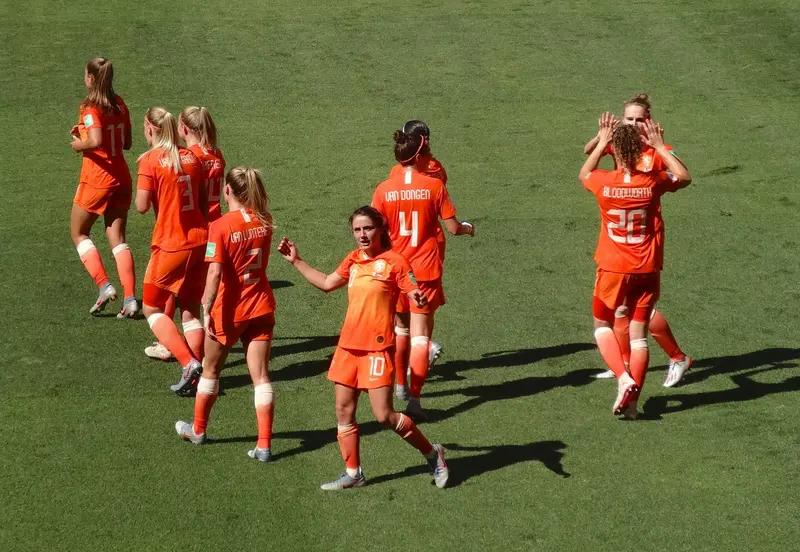
Because this is a team that knows how to win. They were European champions in 2017, on home soil. They reached the 2019 World Cup final, where they lost 2-0 to the United States. And they were quarter-finalists in 2023, knocked out by Spain in extra time before the Spanish team went on to lift the World Cup. For a few years, the Netherlands stopped being an awkward guest and became part of Europe’s top tier.
The turning point was that 2017 European Championship. The team coached by Sarina Wiegman won every match, Lieke Martens became the face of the tournament, Vivianne Miedema scored at the important moments and the final against Denmark became something bigger than a victory. It was a founding image: a country with a huge football tradition suddenly discovering that its women could also fill stadiums, create symbols and build shared memories.
The Netherlands were not starting from scratch. They had already reached the European semi-finals in 2009 —a 2-1 extra-time defeat to England— and had made their World Cup debut in 2015. But nothing had carried the impact of that Euros. The orange shirt no longer belonged only to men’s football. And the success of the national team opened a question that still remains: what happens after a revolution when the revolution is no longer new?
That question runs through Dutch women’s football. It has a recognised national team, exportable footballers and a significant social base. It also has historic clubs such as Ajax, Twente and PSV, and a league that was created in 2007, went through the BeNe League with Belgium and returned in the 2015/16 season as an exclusively Dutch competition.
But the domestic ecosystem still sits below the prestige of its best players. The Vrouwen Eredivisie still cannot compete with England, Spain, France or Germany in economic muscle, weekly following or squad depth. Ajax broke an important barrier in January 2024 by becoming the first Dutch club to reach the quarter-finals of the Women’s Champions League, but that step forward does not erase the wider gap.
Fortuna Sittard summed up that tension well. The club entered professional women’s football in 2022, competed quickly and reached its first cup final in 2024, but the project began to shrink before the following season. A year later, Fortuna decided to shut down its professional women’s team for financial reasons. It was not just a local story. It was a warning: the enthusiasm generated by the national team does not always become sponsorship, attendance, television and a stable project for clubs.
That is the difference between winning and building.
The Netherlands is also a country where women’s sport does not need permission to exist. Its hockey players, cyclists, speed skaters, athletes and swimmers are part of a sporting culture used to seeing its women win. Women’s football did not appear in a desert. It appeared in a country with female sporting role models, but it still had to fight for its own space within the most popular sport.
Vivianne Miedema is the clearest symbol of that era. On 5 July 2025, in the European Championship opener against Wales, she scored her 100th international goal. She was 28. She became the first footballer, male or female, to reach that figure with the senior Netherlands national team. The same team that had won with her, lost finals with her and built part of its identity around the way she understands the penalty area.
That goal gave the tournament a perfect opening image. The Netherlands beat Wales 0-3 in Lucerne and Miedema entered the 100-goal club, the same one we already mentioned here when writing about Belgium’s Tessa Wullaert. But the Euros turned quickly. Then came the 4-0 defeat to England and the 2-5 loss to France. The 2017 European champions finished third in the group and went out in the first round.
The Dutch federation had already decided before the tournament that Andries Jonker would not continue after the Euros. Arjan Veurink, Sarina Wiegman’s assistant with England, took over with a contract until 2029. His mission is not to start from scratch. It is to organise a team that still has talent, memory and expectations, but can no longer rely only on the inertia of its golden generation.
The first real test will be the World Cup play-offs. The Netherlands finished second in their qualifying group, behind France, and will have to seek their ticket to Brazil 2027 over two rounds. The first will be against Hungary in October. If they go through, another tie will follow between late November and early December, against the winner of Turkey v Slovenia.
And that is where another uncertainty appears. On 8 June 2026, Manchester City confirmed that Miedema had undergone knee surgery. The club explained that she would work through the summer with the aim of returning to the team for the 2026/27 pre-season. There is no need to turn that into a confirmed absence for the play-offs, but it is a sign of the moment: their all-time leading scorer reaches this stage between recovery, physical management and a national team that needs to learn not to rely on the same names all the time.
Because the Dutch transition is not only about finding another striker. It is about understanding what remains when Martens is no longer there, when Miedema has to measure every return, when Van de Donk, Groenen and Roord coexist with footballers such as Esmee Brugts, Victoria Pelova and Daphne van Domselaar, and when European football no longer waits for anyone.
The Netherlands do not need to convince their country that women can win. Their cyclists, speed skaters, hockey players and footballers have already done that. Their challenge is different: to make sure women’s football is not only an orange shirt in summer, but a structure that works all year round.
So yes: the Netherlands also play. Only their match is not against Morocco and it does not appear on the main stage of the men’s World Cup. It is being played in the Brazil 2027 play-offs, in Miedema’s recovery, in Veurink’s new era and in a country’s ability to turn that 2017 explosion into something more lasting than a memory.
The Oranje women have already opened a door. Now they have to build a house worthy of what they awakened.