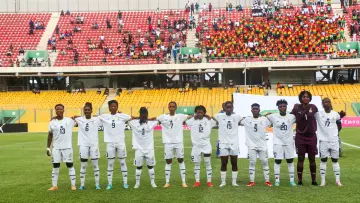
Group D will be the last to begin at the Women’s Africa Cup of Nations and may also be the one that best explains how this edition came together.
Ghana and Cape Verde qualified on the pitch. Cameroon and Mali were eliminated, but were added when CAF expanded the tournament from twelve to sixteen teams and selected the four highest-ranked sides among those that had lost in the final qualifying round.
The result is a group that brings together the bronze medallists from the previous edition, a team that has reached three finals, another that made the quarter-finals only a year ago and a debutant side that has already shown it can compete with them.
It also produces a rematch that is difficult to ignore.
Cape Verde eliminated Mali in October. Nine months later, they will meet again in Casablanca.
Ghana: bronze can no longer be the ceiling
Ghana begin as group favourites for reasons that go beyond their history.
The Black Queens finished third at the 2024 Women’s Africa Cup of Nations after playing three consecutive knockout matches decided on penalties. They overcame Algeria in the quarter-finals, lost to Morocco in the semi-finals and defeated South Africa in the bronze-medal match.
That run restored Ghana to a position they had lost in the preceding years. The national team had reached three continental finals, but missed the 2022 edition and arrived at the most recent tournament without being considered one of the leading contenders.
They no longer arrive as outsiders.
Kim Lars Björkegren’s side retain much of the structure that secured third place. Portia Boakye brings experience in defence; Grace Asantewaa, Evelyn Badu and Alice Kusi offer different solutions in midfield; Princella Adubea, Doris Boaduwaa and Stella Nyamekye provide the attacking threat.
Ghana confirmed their progress in qualifying by defeating Egypt 7-0 on aggregate. Their penultimate friendly, a goalless draw against Tanzania, nevertheless highlighted one of the issues they still need to solve: they can control matches without always turning that dominance into clear chances.
In this group, they will be expected to take the initiative.
Their opening match against Cape Verde comes with an expectation of victory, but the debutants have already punished one team that believed it had the tie under control.
Cameroon: three finals and qualification after elimination
Cameroon return to the Women’s Africa Cup of Nations from an unusual position.
The Indomitable Lionesses have reached three finals, played at the 2015 and 2019 World Cups — missing out on 2023 after losing a play-off to Portugal — and were, for many years, one of the few teams capable of challenging Nigeria’s dominance.
They did not, however, take part in the previous Women’s Africa Cup of Nations and did not qualify directly for this one either.
Algeria defeated them 3-1 on aggregate in the final qualifying round. Cameroon were out until the tournament’s expansion gave them one of the four additional places.
The team also arrive with a recent change in the dugout. Valentine Nguele was appointed on 13 June after impressing with FC Ebolowa Girls. She has had around six weeks to impose her ideas on a side that needs to recover its organisation, confidence and identity.
The squad reflects that transition.
Gabrielle Aboudi Onguéné will play in her eighth Women’s Africa Cup of Nations after sixteen years with the national team. She is still pursuing the only major international title missing from her career. Alongside her is a different generation, represented by Naomi Eto, a 21-year-old midfielder expected to take on increasing responsibility.
Cameroon possess enough experience and talent to progress from the group. The question is not their ceiling, but how quickly Nguele can build a team from players at very different stages of their careers.
Their opening match against Mali will provide an immediate answer.
Mali: eliminated by their future opponents
Mali did not need the expansion to prove that they could compete at a Women’s Africa Cup of Nations.
At the previous edition, they defeated Tanzania, drew with Ghana and reached the quarter-finals, where they were eliminated by Morocco. It was their return to the tournament after a seven-year absence and showed that their fourth-place finish in 2018 had not been an isolated achievement.
That was why their elimination by Cape Verde came as such a surprise.
Mali won the first leg of the final qualifying round 1-0 and travelled to the return match with the advantage. Cape Verde, however, scored four times before Mali could respond. The 4-2 result made it 4-3 on aggregate and left them out of the tournament.
The expansion gave them back an opportunity they had already lost.
The team still possess players capable of changing a match, particularly Aïssata Traoré and Agueissa Diarra, as well as a squad with far more continental experience than Cape Verde. They must also show that their qualifying defeat was an anomaly rather than evidence of a deeper problem.
Their most recent friendly ended in a 1-0 defeat against Ivory Coast. Mali improved after the break and pushed for an equaliser, but once again came away without reward.
Their margin for error will be small from the outset. After opening against Cameroon, they will face Cape Verde in the second round of matches before finishing the group against Ghana.
Cape Verde: their place did not come through expansion
Cape Verde will be one of the two debutant nations at the Women’s Africa Cup of Nations.
Their presence did not depend on the expanded format. They earned it by eliminating a team that had appeared at eight editions and had reached the quarter-finals in the previous tournament.
After losing the first match against Mali 1-0, Silvéria Nédio’s side produced one of the outstanding performances of the qualifying campaign. Larissa Melo, Ivânia Moreira and Eleia Vieira scored inside the opening 24 minutes of the second leg. An own goal then extended their lead to 4-0.
Mali responded with two goals from Oumou Koné, but could not complete the comeback.
Cape Verde therefore became the 28th national team to reach the finals of the Women’s Africa Cup of Nations.
They must now sustain that level across a full tournament.
Ghana, Cameroon and Mali have more experience, deeper squads and players accustomed to international football. Cape Verde, by contrast, have a freedom none of the other three share. They do not need to recover a lost position or justify a place received after elimination.
They have already achieved the objective that once seemed least attainable.
Two matches could shape the group
The opening round will immediately bring together Cameroon and Mali, the two teams that entered the tournament through the expansion.
Victory would allow either side to move ahead in the race to join Ghana in the knockout phase. Defeat would leave them needing points against the favourites or heading into the final match dependent on other results.
Four days later, Mali and Cape Verde will meet again.
The match will not change what happened in qualifying, but it will show how much truly separates the two teams. Mali will have the opportunity to regain in the tournament what they lost in qualifying. Cape Verde will be able to prove that their victory was not built on a single exceptional night.
Ghana should finish first. They have the recent results, the squad and the continuity required to do so.
Second place is far less clear.
Cameroon carry the greatest historical weight, but arrive after elimination and with a new coach. Mali offer greater recent continuity, although it was Cape Verde who knocked them out. The debutants start behind the other three, but have already shown that the group’s hierarchy is not immovable.
Ghana carry the expectation. Cameroon and Mali arrive with a second chance.
Cape Verde were the team that forced Mali to need one.
Group D fixtures (Morocco local time)
Wednesday 29 July
- Ghana v Cape Verde, 18:00
- Cameroon v Mali, 21:00
Sunday 2 August
- Ghana v Cameroon, 18:00
- Mali v Cape Verde, 21:00
Thursday 6 August
- Mali v Ghana, 21:00
- Cape Verde v Cameroon, 21:00
All Group D matches will be played in Casablanca.